 how-to
Boarding Services for Special Needs Dogs: How to Choose
Table of Contents
- What Qualifies as a Special Needs Dog for Boarding
- How to Evaluate a Facility for Special Needs Dog Boarding
- Medication Administration for Boarded Dogs: What to Confirm First
- How to Help a Dog with Separation Anxiety Before and During Boarding
- Trial Stays, Legal Documentation, and Emergency Protocols
- What Special Needs Dog Boarding Costs and Why
- Post-Boarding Decompression: Bringing Your Dog Home
- Frequently Asked Questions
Last Updated: October 2, 2026
What Qualifies as a Special Needs Dog for Boarding
A special needs dog is any dog whose medical, physical, or behavioral requirements go beyond routine feeding, walking, and play, which means boarding services for special needs dogs must deliver more than a standard kennel run.
At Ruffin' It Ranch, we've learned that "special needs" is not one category. It's several, and each one demands a different plan. Below, we break down the two main types and what each means for boarding.
Total Time to Plan a Special Needs Boarding Stay: 2-4 weeks Difficulty: Moderate
Physical Special Needs: Mobility, Chronic Conditions, and Medical Care
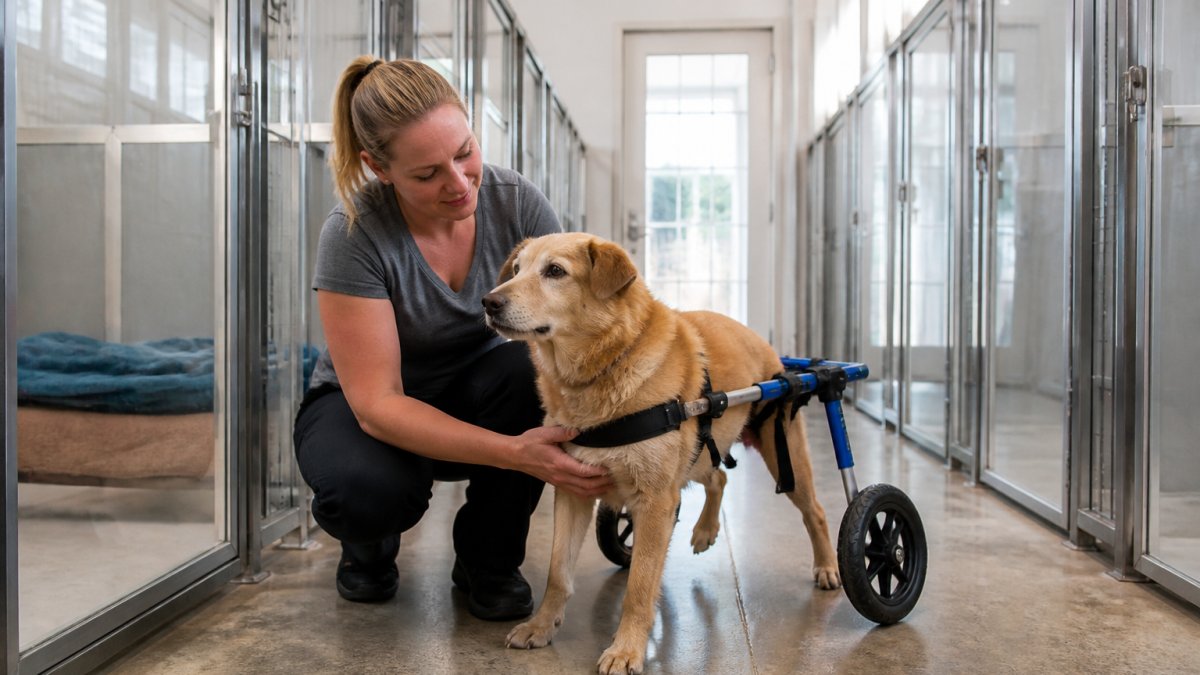
Physical special needs include mobility limitations, chronic conditions, and any dog requiring medication or monitoring during a stay. A paraplegic dog may need bladder expression several times a day. A diabetic dog needs injections on a strict schedule.
The key question is not whether a facility accepts special needs dogs. It's whether the staff can perform the specific tasks your dog requires.
Behavioral Special Needs: Anxiety, Aggression, and Stress Management
Behavioral special needs cover separation anxiety, aggression, reactivity, and severe stress in group settings. These dogs often need the opposite of what a typical boarding facility offers. Instead of open play, they need private runs. Instead of constant activity, they need a calm, predictable routine.
A dog with separation anxiety may do fine in a home setting but fall apart in a kennel with barking neighbors. An aggressive rescue dog may be perfectly manageable one-on-one but unsafe in a play group.
How to Evaluate a Facility for Special Needs Dog Boarding
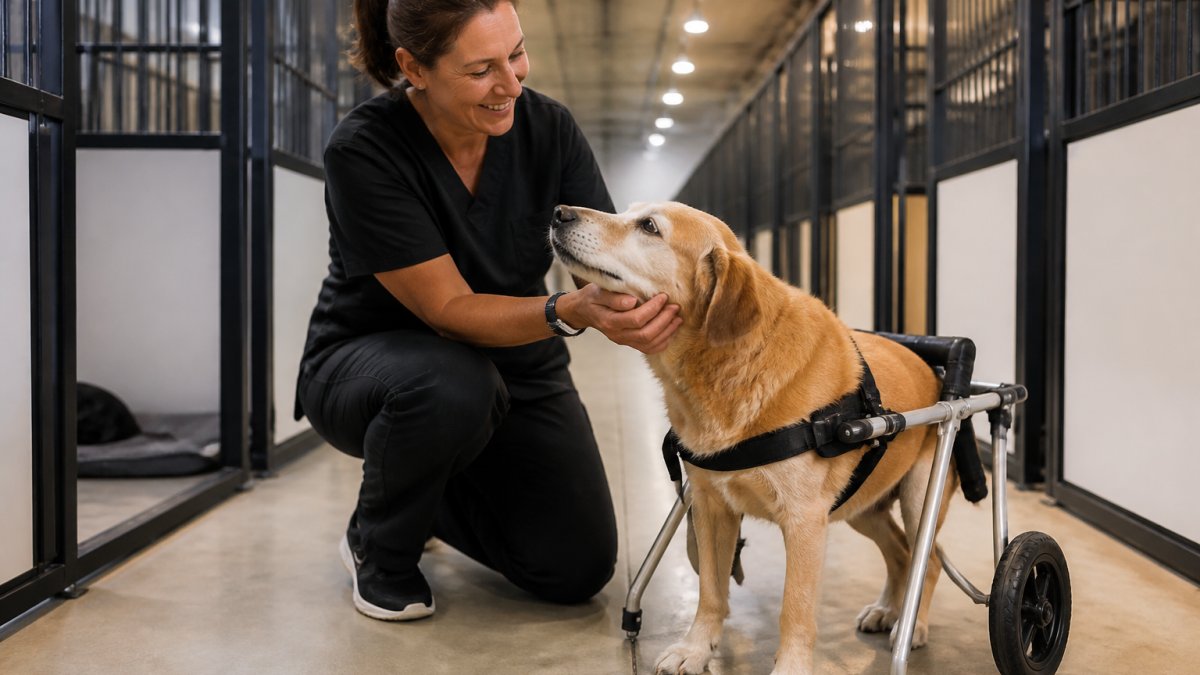
The best way to evaluate a facility is to tour it in person, ask specific questions about your dog's condition, and watch how staff interact with the animals already there.
Ask to see the actual space your dog will use, not a showroom. Watch whether the runs are clean, whether the temperature is controlled, and whether staff seem calm and unhurried.
Here's a checklist to bring with you:
- Can staff name the specific medications your dog takes and how they're administered?
- Is there overnight supervision, or does the building go quiet at night?
- Are runs private, or does your dog share walls with unfamiliar dogs?
- How are aggressive or anxious dogs separated from the general population?
- What is the protocol if your dog refuses to eat or shows signs of distress?
- Can you get updates, photos, or video during the stay?
- Who is trained to handle medical emergencies, and how fast can a vet be reached?
Medication Administration for Boarded Dogs: What to Confirm First
Medication administration for boarded dogs should be confirmed in writing before you book, including dosage, timing, storage, and who is authorized to give each dose. Verbal assurances are not enough. A missed insulin dose or a doubled pill can become an emergency fast.
Bring medications in their original labeled containers with clear instructions. Ask the facility to log every dose and to contact you or your vet if anything is missed.
How to Help a Dog with Separation Anxiety Before and During Boarding
You can reduce separation anxiety by preparing your dog weeks before the stay, keeping drop-off calm, and choosing a facility that offers private space and predictable routines.
Start with short practice separations at home. Leave for 15 minutes, then 30, then an hour. Keep departures and returns low-key.
A trial stay helps more than any amount of preparation. Book one night, then two, before a longer trip.
Trial Stays, Legal Documentation, and Emergency Protocols
A trial stay is the single most useful tool for a special needs dog, and it deserves its own protocol. Book one night, then two, before any long trip. This lets your dog adjust to the space, the sounds, and the staff, and it lets the facility learn your dog's baseline behavior, appetite, and medication response while you are still nearby to fix problems.
A trial stay checklist should include:
- Drop off at a low-traffic time so staff can focus on your dog
- Provide written medication instructions and confirm the first dose is logged
- Ask for a photo or text update at the midpoint of the stay
- Confirm who is on duty overnight and how they reach your vet
- Pick up at a calm time and ask for a written behavior and appetite report
- Note any changes in your dog's behavior for 24 hours after pickup
Before any stay, sign a written agreement covering emergency veterinary care, liability, and your contact preferences. A good agreement names your primary vet, your emergency contact, and the dollar limit you authorize for treatment without prior approval.
Ask these questions before signing:
- Who decides when to call a vet, and how quickly?
- What is the spending limit before you are contacted?
- Which vet or emergency hospital does the facility use after hours?
- What happens if your dog injures another dog or a staff member?
- Are vaccination requirements, including bordetella and rabies, documented and current?
- Does the agreement cover pre-existing conditions, or only new emergencies?
- What is the protocol if your dog's condition changes mid-stay?
A facility that hesitates on any of these is not ready for special needs care. Documentation is not bureaucracy. It is the difference between a fast, correct response and a delay that costs your dog.
What Special Needs Dog Boarding Costs and Why
Special needs boarding costs more than standard boarding because it takes more staff time, more space, and more training. A dog that needs medication three times a day, private runs, and one-on-one attention cannot be cared for at the same rate as a dog that joins open play.
Pricing depends on the level of care, the length of stay, and the facility. Some facilities charge a base nightly rate plus add-ons for medication, private runs, or special diets. Others bundle everything into a higher flat rate. Ask for a full written breakdown before you book, and confirm what happens if your dog's needs change mid-stay.
| Care Need | Why It Costs More | What to Ask |
|---|---|---|
| Medication administration | Staff time and training required | Is there an added fee per dose? |
| Private run | Takes up space that could house another dog | Is the private run guaranteed? |
| Special diet | Separate prep and storage | Is food included or do you supply it? |
| One-on-one attention | Dedicated staff hours | How many sessions per day? |
| Medical monitoring | Veterinary coordination | Who is on call after hours? |
American Veterinary Medical Association guidance on boarding facility standards
Post-Boarding Decompression: Bringing Your Dog Home
Post-boarding decompression is the phase most owners overlook, and it matters most for special needs dogs.
Keep the first evening quiet. Skip the dog park, skip visitors, and skip big changes. Offer water, a normal meal, and a calm space.
For special needs dogs, watch these specific signals in the first 72 hours:
- Medication rebound: If your dog missed or received a different dose timing, watch for changes in energy, appetite, or behavior.
- Stress behaviors: Increased panting, pacing, hiding, or clinginess can signal that the transition is harder than expected.
- Physical changes: Limping, stiffness, or reluctance to move may mean the boarding environment aggravated a mobility issue.
- Appetite and digestion: Refusal to eat, vomiting, or diarrhea lasting more than a day needs a vet call.
A common pattern is a dog that seems fine for the first 24 hours, then shows stress behaviors on day two or three.
At Ruffin' It Ranch, we plan for the transition home as carefully as the stay itself. Our 24/7 on-site professional staff, climate-controlled environment with large private indoor and outdoor space, and individualized care plans mean your dog's routine stays consistent from drop-off to pick-up.
Frequently Asked Questions
What qualifies as a special needs dog for boarding purposes?
A dog qualifies as special needs for boarding if it requires medication administration, mobility assistance, a special diet, behavioral support, or overnight supervision beyond what a standard kennel provides. This includes dogs with chronic conditions like diabetes or epilepsy, paraplegic or wheelchair-bound dogs needing bladder expression, dogs with severe separation anxiety, and aggressive rescues that cannot join group play. Facilities equipped for these cases typically ask for a pre-boarding assessment and current pet health records before confirming a reservation.
How do I prepare my special needs dog for a stay at a boarding facility?
Schedule a trial stay of one or two nights well before your trip so your dog adjusts to the environment and staff. Provide written medication administration instructions with exact dosages and timing, vaccination requirements documentation, and a summary of your dog's customized routine at home. Send familiar bedding and toys to reduce stress. If your dog takes injections or needs bladder expression, ask staff to demonstrate the technique during the trial stay so you can confirm they are comfortable with it.
Can boarding facilities accommodate dogs that require medication or physical assistance?
Yes, but capability varies widely. Veterinary-based boarding operations have professional staff trained in medication administration, including injections and monitoring for side effects. Standalone facilities may also handle this if they have certified staff and clear emergency protocols. Ask directly whether someone is on-site overnight, how medications are logged, and what happens if your dog refuses a dose. For mobility assistance such as bladder expression or help with a wheelchair-bound dog, request a facility tour and watch how staff handle other special needs pets.
What questions should I ask before booking special needs dog boarding?
Ask about staff training and certification levels, whether overnight supervision is truly 24/7, how medication administration is documented, and what emergency protocols exist if your dog's chronic condition flares up. Request a facility tour to check accessibility features and kennel alternatives like private runs. Confirm pricing structure for add-on medical care, whether a trial stay is required, and what legal and liability documentation you must sign. Also ask how behavioral support is handled for dogs with separation anxiety or aggression.