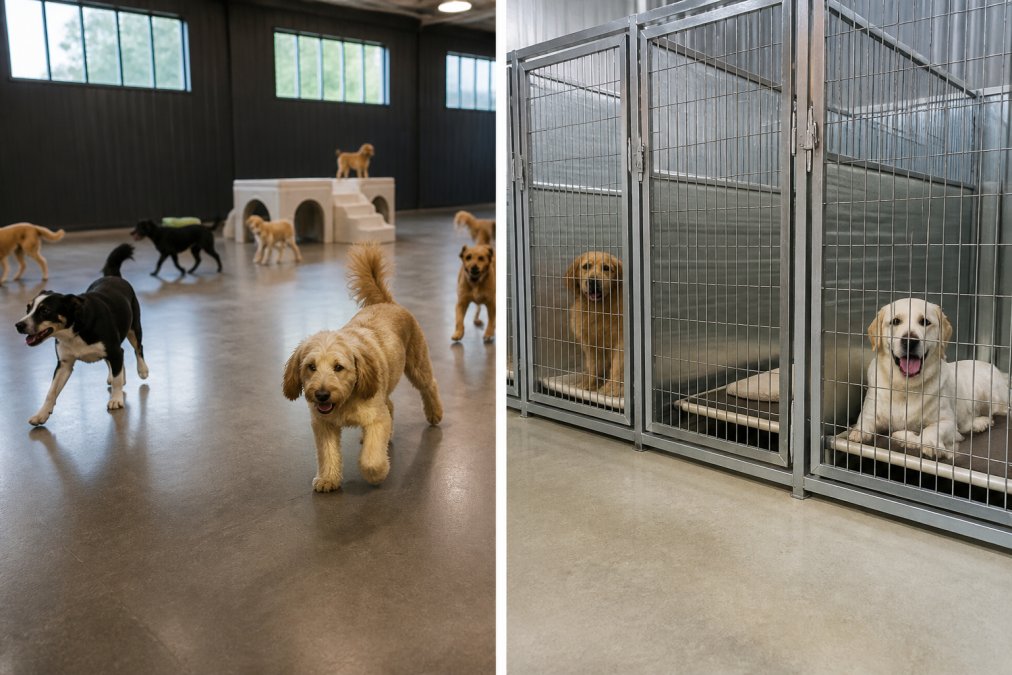
 comparison
Cage Free vs Kennel Boarding: Which Is Best for Your Dog?
Table of Contents
- Cage Free vs Kennel Boarding: A Side-by-Side Comparison
- Pros and Cons of Cage-Free Boarding
- Pros and Cons of Traditional Kennel Boarding
- Dog Boarding Requirements: Vaccinations, Temperament, and Paperwork
- How to Prepare Your Dog for Boarding
- Dog Boarding for Senior Dogs and Dogs With Special Needs
- Cost, Medical Needs, and Emergency Protocols: What to Ask Before You Book
- Frequently Asked Questions
Last Updated: September 13, 2026
Cage Free vs Kennel Boarding: A Side-by-Side Comparison
Choosing between cage free vs kennel boarding comes down to one question: does your dog do better with freedom and company, or with a quiet, contained space of their own? This guide from Ruffin' It Ranch breaks down both models.
Cage-free boarding is a boarding model where dogs spend the day (and often the night) loose in a supervised group or private suite rather than confined to an individual kennel run. Traditional kennel boarding houses each dog in a separate run or crate for most of the stay, with exercise and bathroom breaks on a schedule.
Neither model is universally better. The right fit depends on your dog's personality, socialization history, and medical needs.
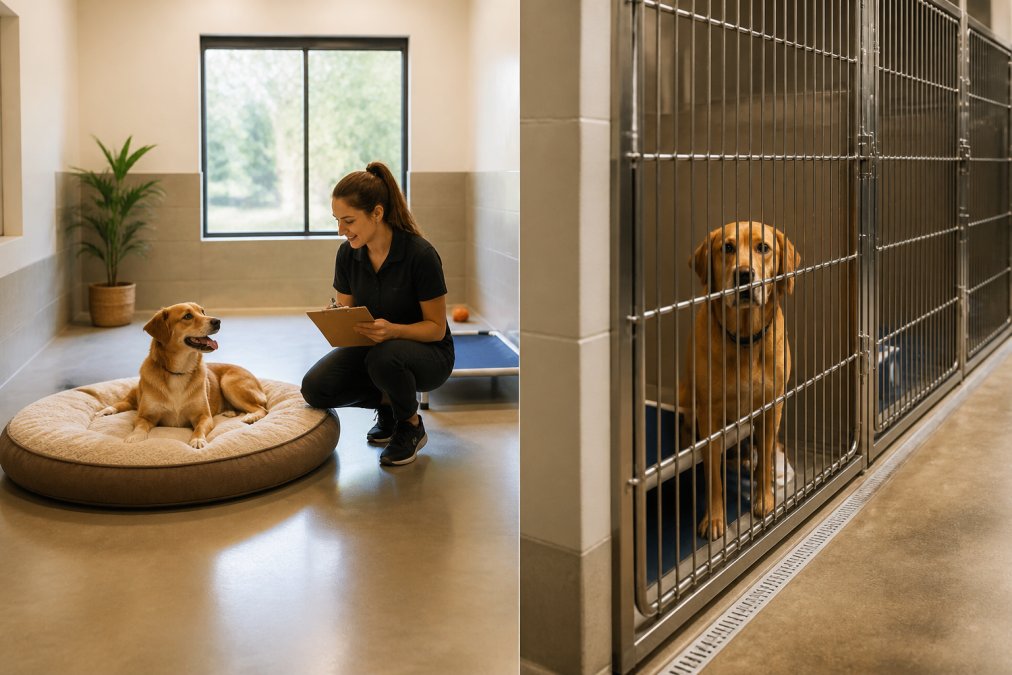
What Cage-Free Boarding Actually Looks Like
Cage-free boarding means dogs are not confined to individual kennels. They rotate between supervised group play, rest in open suites or home-style rooms, and outdoor time.
Dogs are grouped by size, energy level, and temperament after an assessment. Staff supervise play, separate dogs for meals and rest, and build in structured downtime because overtired dogs get cranky.
The honest caveat: cage-free only works for dogs who genuinely enjoy other dogs. A dog who tolerates the group but never relaxes is not getting a vacation.
How Traditional Kennel Boarding Works
Traditional kennel boarding gives each dog a private run or crate, with scheduled exercise and potty breaks. The dog rests between activities rather than choosing when to socialize.
This model suits dogs who find other dogs stressful. The run becomes a den, and many dogs sleep more soundly in a contained space, especially those comfortable with crate training. Staff-to-dog attention is typically lower than in cage-free settings, though quality facilities still provide individual attention and outdoor time.
The trade-off is stimulation: a dog in a run most of the day needs the exercise blocks to actually happen.
Pros and Cons of Cage-Free Boarding
Cage-free boarding wins on socialization and stress reduction for the right dog, and loses for the wrong one.
Pros:
- Supervised group play meets exercise needs without scheduled walks
- Reduced stress for dogs who dislike confinement
- Natural socialization with other dogs
- More human interaction throughout the day
Cons:
- Not suitable for reactive dogs or dogs with resource guarding habits
- Higher injury risk from rough play, even with supervision
- Kennel cough spreads faster in group settings
- Overstimulation can leave some dogs exhausted rather than relaxed
Pros and Cons of Traditional Kennel Boarding
Traditional kennels win on safety, predictability, and suitability for a wider range of temperaments, and lose on stimulation and social contact.
Pros:
- Lower disease transmission between dogs
- Ideal for reactive, fearful, or dog-selective dogs
- Predictable routine supports anxious dogs
- Easier for facilities to guarantee rest and sleep quality
Cons:
- Less exercise and mental stimulation unless staff deliver scheduled play
- Can increase stress in dogs with separation anxiety
- Kennel runs feel institutional to some dogs
- Quality varies enormously between facilities
| Factor | Cage-Free Boarding | Traditional Kennel Boarding |
|---|---|---|
| Best for | Social, high-energy dogs | Reactive, fearful, dog-selective dogs |
| Exercise | Group play throughout day | Scheduled blocks |
| Disease risk | Higher (group contact) | Lower (separated) |
| Stress level | Low for social dogs, high for others | Low for den-comfortable dogs |
| Supervision needs | Constant, low ratio | Periodic checks, scheduled interaction |
| Sleep quality | Depends on rest periods | Generally reliable |
Dog Boarding Requirements: Vaccinations, Temperament, and Paperwork
Most facilities require current vaccination records, a temperament assessment, and a completed intake form before your dog's first stay. But requirements differ between the two models.
Vaccination and medical screening: where the two models diverge
Both cage-free and traditional kennel boarding typically require proof of rabies, distemper, and Bordetella (kennel cough) vaccination, plus flea and tick prevention. The divergence is in how strictly those requirements are enforced.
- Cage-free facilities tend to enforce vaccination requirements more rigidly because dogs share air, water bowls, and play space. Many also require a negative fecal float within the past 6-12 months, a clean respiratory check, and sometimes a canine influenza vaccine. A single unvaccinated dog in an open play group can expose dozens of others before anyone shows symptoms.
- Traditional kennels still require core vaccines, but because dogs are separated by runs or crates, some facilities are more flexible on non-core vaccines and accept titer results in place of recent boosters. That flexibility is not automatically safer, it just shifts the risk calculation.
Cage-free facilities often turn away a dog with a recent cough, a draining ear, or an unresolved skin issue, while a kennel may accept the dog with a vet's note. Know which one you're walking into before drop-off day.
The temperament test: the real barrier to cage-free
Cage-free boarding almost always requires a temperament evaluation, a trial day, meet-and-greet, or assessment, before the first overnight stay. This is the biggest practical difference between the two models.
What the assessment usually involves:
- A short supervised introduction to one calm, stable dog, then a gradual introduction to a small group.
- Observation of body language: does your dog stiffen, freeze, tuck its tail, or try to mount or guard toys and water?
- A handling check, can staff touch paws, ears, and collar without a stress response?
- A separation check, how does the dog react when you leave the building?
Most facilities run this as a half-day or full-day session, often at a reduced rate or free, and many require it repeated if more than 6-12 months pass between stays. If your dog fails, the facility will usually refer you to a traditional kennel or a facility with private suites, a useful signal, not a rejection.
Traditional kennels rarely require a temperament test because dogs are not mixing, making them the default for reactive, dog-selective, or fear-aggressive dogs.
Paperwork to have ready
- Current vaccination records from your veterinarian, including expiration dates
- Rabies certificate (not just the tag number)
- Negative fecal test result, if required
- Proof of flea and tick prevention
- Written medication instructions with dosing times
- Emergency contact and your veterinarian's phone number
- Signed intake and liability forms
CDC guidance on kennel cough in group settings
What to ask about medical emergencies
Before you sign anything, ask two questions: Which veterinarian do you use after hours, and what is your protocol if my dog needs emergency care while I'm unreachable? A facility that cannot answer both specifically is not ready for a dog with any medical history.
How to Prepare Your Dog for Boarding
Preparation starts weeks before drop-off, not the morning of.
- Schedule a trial day or overnight stay at least two weeks ahead
- Update vaccinations and gather records in one folder
- Send your dog's regular food, labeled with feeding amounts
- Pack a worn t-shirt or blanket that smells like home
- Confirm medication instructions in writing if your dog takes any
- Practice short separations in the weeks before the trip
- Keep drop-off calm and brief; long goodbyes raise anxiety
For dogs prone to separation anxiety, a trial night reveals how they actually handle being away. Some dogs surprise you and settle within hours. Others need a facility with more individual attention or a quieter environment. The American Veterinary Medical Association's pet owner resources covers separation anxiety basics worth reviewing before boarding.
Dog Boarding for Senior Dogs and Dogs With Special Needs
Senior dogs and dogs with special needs need a facility equipped for individualized care, not just a bed and a bowl. Ask directly about mobility support, medication administration, and quiet rest space.
Older dogs often do better in a private run or suite than in group play. Arthritis, vision loss, and hearing loss make rough play risky, and seniors need more rest than the group schedule allows. Prioritize a facility that can separate your senior for naps and one-on-one time.
Dogs with diabetes, seizure disorders, or post-surgical restrictions need a facility that documents medication timing and can reach your vet. Puppies need a complete vaccination series, plus staff equipped for extra supervision and potty breaks.
Cost, Medical Needs, and Emergency Protocols: What to Ask Before You Book
Cage-free boarding usually costs more, and understanding why helps you decide whether the premium buys something your dog actually needs.
Why cage-free often costs more, and when it's worth it
The premium is driven by three real cost inputs, not marketing:
- Staffing ratios. Group play requires constant supervision. A cage-free facility may run one staff member per 10-15 dogs during play, while a traditional kennel can safely operate at one per 25-40 because dogs are contained. Labor is the largest line item in any boarding facility's budget.
- Space per dog. Open play areas, rest suites, and separate zones for size and temperament groups consume more square footage than a bank of runs.
- Screening and intake labor. Temperament assessments, vaccination verification, and trial days take staff time that kennels do not spend.
If your dog is social, high-energy, and genuinely enjoys other dogs, the premium buys exercise and companionship. If your dog is dog-selective, anxious, or a senior, you are paying for a service your dog will not use, and a traditional kennel at a lower rate may deliver a better stay.
Ask for a written rate sheet that breaks out:
- Base nightly rate
- Additional dog discount, if any
- Medication administration fee (common, and often per dose)
- Special feeding or raw diet handling fee
- Holiday and peak-season surcharges
- Late pick-up or early drop-off fees
- Assessment or trial day fee
A facility that quotes a single number without a breakdown usually adds fees at pick-up.
Medical needs: what each model can and cannot handle
- Medication timing. Cage-free facilities can administer medication, but the dog is often in a group when doses are due. Ask how they pull a dog out of play without triggering a guarding or escape response.
- Injections. Insulin and other injectables require a staff member trained and willing to administer them. Not every facility will, regardless of model.
- Post-surgical or mobility-restricted dogs. These dogs need a private run or suite, a traditional kennel or a cage-free facility with private rooms, not open group play.
- Seizure or diabetic dogs. Ask whether anyone is on-site overnight, not just on-call. A dog in a private run during a seizure needs a human within seconds, not a phone call.
Emergency and disaster protocols: the question most owners never ask
This is where the two models genuinely differ.
In a cage-free, open-floor plan:
- A fire, power loss, or evacuation requires staff to leash and move multiple loose dogs at once. Ask how many staff are on-site overnight and how they physically move a group of dogs out of the building.
- If the HVAC fails in summer, an open play area can heat up faster than individual runs because there are no separating walls to slow air movement. Ask about backup power and temperature monitoring.
- In a fight or injury, separating dogs in an open room is harder than closing a run door. Ask what barriers, air horns, or break sticks staff keep on the floor.
In a traditional kennel:
- Evacuation is slower per dog because each run must be opened individually, but each dog is already contained and easier to leash one at a time.
- Disease outbreak containment is simpler, one sick dog can be isolated without moving the whole population.
- The risk is the opposite of cage-free: a dog in distress in a run may go unnoticed longer if staff checks are periodic.
Questions that force a specific answer:
- How many staff are physically on-site between 10 p.m. and 6 a.m.?
- What is your written evacuation plan, and when was it last practiced?
- Do you have backup power for heating and cooling?
- Which emergency veterinary hospital do you use after hours, and how far is it?
- How do you reach me if my phone is off, is there a secondary contact on file?
- What is your protocol if my dog does not settle in the first 24 hours?
At Ruffin' It Ranch, our staff is on-site 24/7 in a climate-controlled facility with large private indoor and outdoor runs. We're equipped to care for puppies and dogs that other facilities turn away, including those with behavioral challenges, and we offer cage-free grooming alongside our boarding and daycare services. If your dog needs a signature crafted raw diet or individualized attention throughout their stay, our team can accommodate that.
USDA Animal and Plant Health Inspection Service pet travel and care resources
Frequently Asked Questions
What are the primary differences between cage-free and traditional kennel boarding?
Cage-free boarding gives dogs room to move, socialize, and rest in a home-style environment with supervised group play and individual attention. Traditional kennel boarding houses each dog in a separate kennel run, limiting interaction but offering more control over routine, rest, and stress for dogs that prefer solitude. Neither is universally better; the right fit depends on your dog's personality, temperament, and medical needs.
Is cage-free boarding safer for dogs with anxiety?
It depends on the dog. Some anxious dogs relax in a cage-free setting because they are not confined and can move freely, which can reduce separation anxiety. Others become more stressed by unfamiliar dogs and constant activity. A reputable facility will do a temperament assessment and may recommend a private run, structured routine, and scheduled rest periods instead of open group play for anxious or reactive dogs.
How do I know if my dog is a good candidate for cage-free boarding?
Dogs that are socialized, comfortable around other dogs, and not prone to resource guarding usually do well in cage-free boarding. Dogs that are fearful, reactive, or protective of food and toys often do better in a private run with individual attention. Most facilities offer a facility tour and introductory visit so staff can assess your dog's temperament before the first overnight stay.
What safety standards should I look for in a boarding facility?
Ask about staff-to-dog ratios, supervised group play, vaccination requirements, hygiene standards, and whether staff are on-site 24/7. A good facility will require current vaccination records, including kennel cough, and will separate dogs by size and temperament. Emergency protocols matter too: ask how the facility handles injuries, after-hours illness, and natural disasters, and confirm they have a relationship with a local veterinarian.
Does cage-free boarding provide more socialization than traditional kennels?
Cage-free boarding typically offers more supervised group play, which supports socialization and exercise needs for friendly dogs. Traditional kennels usually provide individual attention and limited interaction, which can be better for dogs that find other dogs overwhelming. If socialization is your goal, ask how play groups are structured, how staff manage resource guarding, and whether rest periods are built into the daily routine.