 how-to
How to Monitor Your Dog While Boarding: 2026 Guide
Table of Contents
- Before Drop-Off: Questions to Ask Dog Boarding Facilities
- Dog Boarding Webcam Access: What to Look For and How to Use It
- How to Monitor Your Dog While Boarding: A Daily Check-In Routine
- Signs of Stress in Boarded Dogs and What to Do About Them
- Luxury Dog Boarding for Senior Dogs: Monitoring Mobility and Comfort
- How Often Should You Check In Without Adding to Your Dog's Stress?
- Frequently Asked Questions
Last Updated: September 16, 2026
Before Drop-Off: Questions to Ask Dog Boarding Facilities
Monitoring your dog while boarding starts at the tour, not from a hotel room three states away. Ask direct questions; treat vague answers as a red flag.
Camera, Update, and Staffing Questions That Matter Most
- Is there a live webcam or video stream I can access? If yes, ask which areas it covers and whether it runs overnight.
- How often do you send daily updates, and by what method? Text, email, and app notifications all work, but you need to know the frequency in advance.
- Who is on-site overnight? A 24/7 staffed facility differs from one with a camera and no humans present.
- What is your protocol for a dog that stops eating? You want a defined response, not a shrug.
- Can you send photos of my dog during playtime or rest periods?
- How do you handle a dog with separation anxiety or one that shows stress signals?
Staffing matters more than most owners realize: structured rest and supervised play only happen when enough trained people are present.
Dog Boarding Webcam Access: What to Look For and How to Use It
Dog boarding webcam access is the most requested feature among traveling pet owners, and the most misunderstood. A camera is a window, not a guarantee: what you see depends on where it points, how often a human is in frame, and whether the feed is live.
When you evaluate webcam access, check five things:
- Coverage. Does the camera show the actual run your dog uses, or just a common play area? Ask for the field of view in writing.
- Resolution and frame rate. A wide, low-resolution shot hides more than it reveals. A feed refreshing every few seconds is a slideshow, not live video, confirm the difference.
- Human presence. The most reassuring feed shows staff interaction, not an empty room at 2 a.m.
- Latency. Ask how much delay exists between real time and what you see. A 30-second delay is normal; a 10-minute delay means you are watching history.
- Retention. Does the facility record footage, and for how long? Recorded feeds help resolve disputes; live-only feeds do not.
Privacy and Security: Who Else Can See Your Dog's Feed
A public webcam feed is a shared feed. If the stream is posted without a login, anyone with the URL can watch your dog, other people's dogs, and any staff or visitors in frame, a privacy consideration most boarding guides never mention.
Ask these questions before you rely on a feed:
- Is the stream public or password-protected? A per-client login tied to your reservation is safer than a shared password posted on a lobby sign.
- Is the connection encrypted? Look for
https://in the address bar. An unencryptedhttp://stream can be intercepted on public Wi-Fi. - Does the facility rotate credentials between stays? A password that never changes is one former clients still have.
- Are other owners' pets visible? If yes, your dog is equally visible to them.
- What is the facility's policy on screenshots and recording? Some prohibit clients from capturing or reposting footage of other animals.
Troubleshooting a Webcam That Won't Load
- Confirm you are on a stable network. Hotel and airport Wi-Fi drops video streams constantly.
- Try a different browser or disable any VPN, which can block the stream.
- Check whether the feed runs on a schedule and is offline during rest periods.
- Clear your browser cache and reload.
- Test on a second device. If the feed loads on your phone but not your laptop, the problem is local.
- Check the facility's status page or social feed. Planned maintenance is usually announced there.
- Contact the facility directly. A quick text usually resolves authentication or link issues faster than troubleshooting alone.
Most facilities will text a photo on request, which solves the problem when the stream is unreliable. If the feed is down for more than a few daytime hours, ask for a written explanation and a photo.
How to Monitor Your Dog While Boarding: A Daily Check-In Routine
A daily check-in routine keeps you informed without turning your vacation into a surveillance shift. The goal is consistency: same times, same questions, same short notes so you can spot changes.
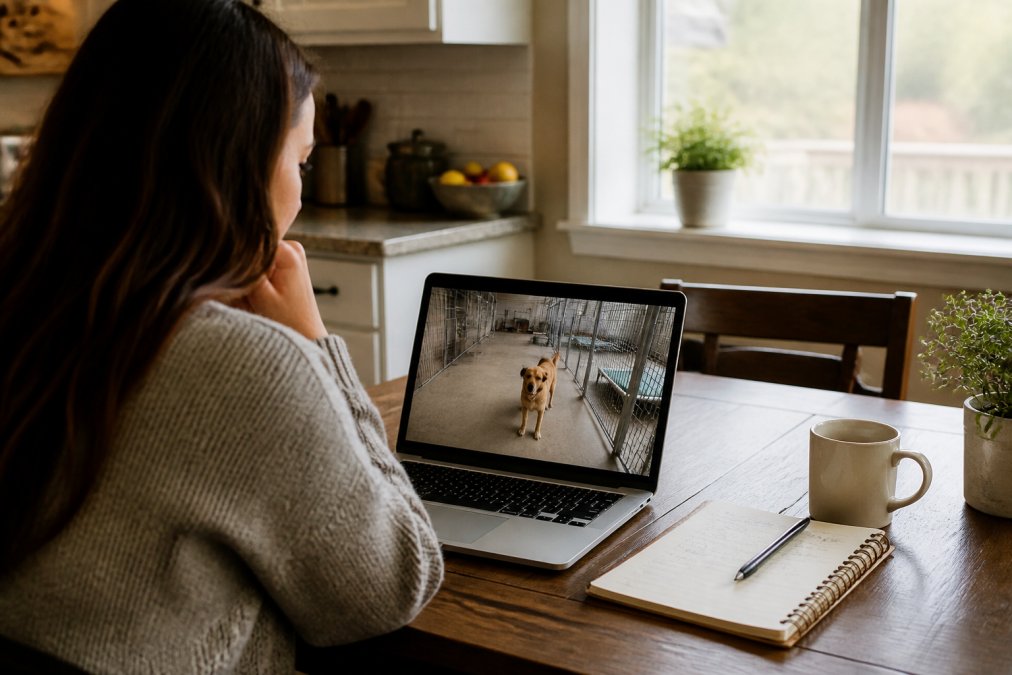
Here is a routine that works for most owners:
- Morning: Review any overnight update. Note appetite and whether your dog ate eagerly.
- Midday: Watch the live webcam for five to ten minutes. Look at body language, not just presence.
- Afternoon: Send one specific question to staff if something looked off.
- Evening: Log a one-line summary: energy, mood, eating, bathroom habits.
| What to Check | How Often | What "Normal" Looks Like |
|---|---|---|
| Appetite and water intake | Every update | Eagerness to eat, steady drinking |
| Bathroom habits | Daily | Consistent, no accidents reported |
| Energy levels | Twice daily | Alert, engaged, willing to move |
| Body language | On camera | Relaxed behavior, loose wagging tails |
| Mobility | Daily (seniors) | Steady walking, no stiffness |
Signs of Stress in Boarded Dogs and What to Do About Them
Recognizing stress signals early is the difference between a dog that settles in and one that spirals. Even well-adjusted dogs show adjustment behavior in the first 24 to 48 hours; the key is distinguishing normal settling from genuine distress.
Reading the Camera: What Stress Actually Looks Like on a Feed
A single glance at a webcam can mislead you: a dog lying still may be resting or shut down, and a pacing dog may be anxious or just anticipating a walk. Watch a continuous 5- to 10-minute window and score what you see:
- Body posture. A relaxed dog has a soft, curved topline and a loose tail. A stressed dog has a stiff, level back, a tucked tail, or a hunched posture.
- Ears and eyes. Flattened ears, whale eye (whites showing), or a hard stare with no blinking indicate tension. Soft, blinking eyes and neutral ears indicate comfort.
- Mouth and tongue. Lip licking, repeated yawning, and panting without exercise are displacement signals. A relaxed dog may pant after play but recovers within a minute or two.
- Movement pattern. Pacing in a fixed loop, circling the run, or pressing against a wall or door differs from exploratory sniffing or play bowing.
- Response to staff. A dog that approaches staff with a loose, wiggly body is settling. A dog that freezes, retreats, or flattens when a person enters is not.
- Vocalization. Whining, howling, or repetitive barking past the first night is a signal. Occasional alert barking at a passerby is not.
The Escalation Ladder: What to Do, In Order
Most guides stop at "tell the facility." That is not a plan. Use this ladder, moving up only when the level below has not worked within 24 hours:
- Mild adjustment (first 24-48 hours). Pacing, reduced appetite, or whining on night one is common. Ask the facility to keep feeding, walking, and rest times identical to your dog's home schedule, and to avoid new playmates during this window.
- Persistent mild signs (48-72 hours). If the dog is still not eating full meals or is pacing at every check, request one-on-one staff interaction, a hand-fed meal, a solo leash walk, or quiet time in a low-traffic area. Ask for a written note in the next update describing what was tried.
- Moderate distress (any time). Refusing food for more than 24 hours, repeated howling, or visible freezing around staff warrants a phone call, not a text. Ask specifically: has the dog eaten, eliminated, and slept, and has a staff member spent one-on-one time with the dog today?
- Severe or escalating distress. If the dog is not eating for more than 48 hours, is injuring itself against the run, or is unresponsive to staff, ask the facility to contact your veterinarian and arrange a pickup or transfer to a veterinary boarding option. Have your vet's name, phone number, and authorization on file before drop-off so this step is not delayed.
Anxiety Management Protocols to Ask About Before Drop-Off
Anxiety management is not the same as "we love dogs." Ask the facility to describe its protocol:
- What calming tools are permitted? Some facilities allow a familiar blanket, a worn t-shirt with your scent, or a specific chew toy. Others restrict anything that could be a choking hazard when unsupervised.
- Is there a quiet zone? A run away from the front desk, the door, and the main play group reduces visual and auditory triggers.
- Are pheromone diffusers or calming supplements used? Ask whether the facility uses them and whether they require written consent.
- Is there a documented behavior plan? A facility that handles separation anxiety will have a written intake form asking about triggers, past boarding experiences, and what calms your dog at home.
- What is the threshold for calling you? Get the specific trigger in writing, for example, "we call if a dog refuses food for two consecutive meals or shows signs of distress for more than four hours."
Luxury Dog Boarding for Senior Dogs: Monitoring Mobility and Comfort
Luxury dog boarding for senior dogs is less about marble floors and more about comfort, mobility, and individualized care. Older dogs need softer bedding, shorter play sessions, warmer temperatures, and staff trained to notice subtle changes.
- Mobility checks. Can your dog rise, walk, and lie down without struggling?
- Appetite monitoring. A senior that skips meals needs attention faster than a young dog.
- Rest quality. Seniors need more sleep, so a dog restless at night may be uncomfortable.
How Often Should You Check In Without Adding to Your Dog's Stress?
Check in once or twice a day, and no more. That surprises owners who assume more contact is better.
Use this as your guide:
- One scheduled update per day from staff, plus photos.
- One live webcam check for five to ten minutes.
- One direct question only if you saw something specific worth asking about.
Frequently Asked Questions
How often should I check in on my dog while boarding?
Once or twice a day works best for most owners. Ask the facility how often they send updates, since many provide scheduled photos or videos rather than a constant feed. Checking more frequently tends to increase your own anxiety without changing your dog's care. If your dog has special needs, agree on a specific update schedule at drop-off so you know exactly when to expect news.
Do most dog boarding facilities offer live webcams?
It varies widely. Some facilities stream play areas or private runs around the clock, while others send daily photo and text updates instead. Ask directly during your tour whether dog boarding webcam access is included, whether it covers rest areas or only playtime, and whether you need a login. If cameras aren't available, ask how often staff will send updates and what those updates include.
What are the signs that a dog is stressed at a boarding facility?
Watch for tucked tails, flattened ears, pacing, excessive panting without exercise, lip licking, yawning out of context, and refusing food or water. A dog that hides in the back of the run or freezes during playtime is also showing stress. Mild signs often fade within a day or two as the dog settles. If stress signals persist or worsen, ask staff about adjusting the routine, adding solo playtime, or arranging a check-in with your veterinarian.
Should I call the kennel every day to check on my dog?
Daily calls aren't necessary if the facility already sends updates, and frequent calls can pull staff away from the animals. A better approach is to agree on an update schedule at drop-off, for example a photo each morning and a note about appetite and bathroom habits. Save calls for real concerns, like a change in medication, a new symptom, or a question about your dog's behavior that the written updates don't cover.