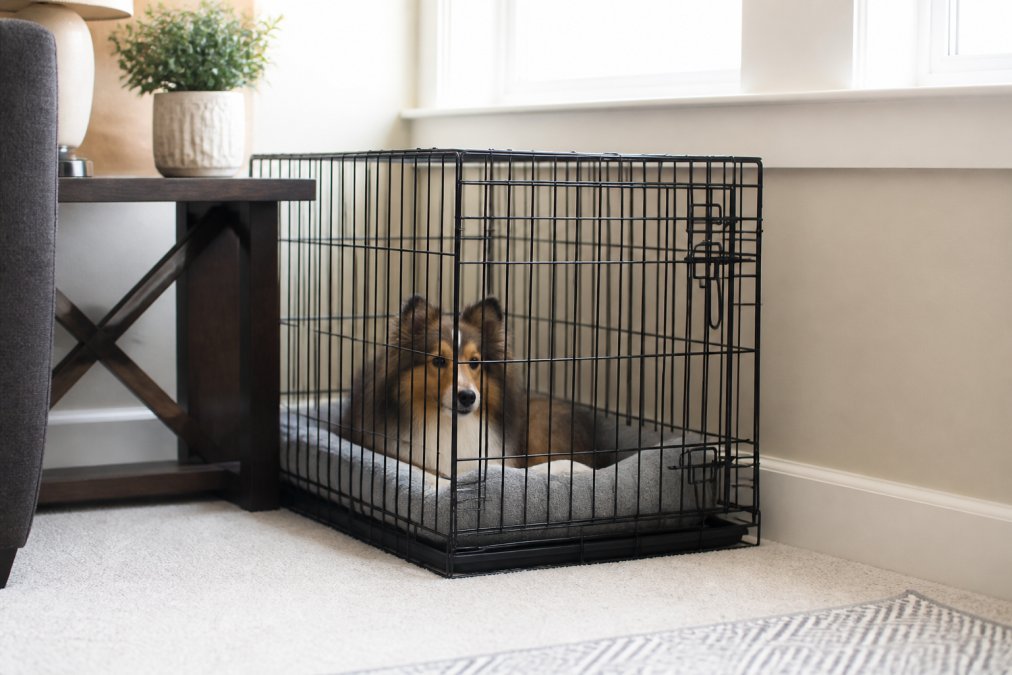
 ultimate-guide
How to Crate Train a Dog With Separation Anxiety
Table of Contents
- Why Crate Training Backfires for Anxious Dogs
- Signs of Separation Anxiety in Dogs vs. Normal Crate Whining
- Setting Up a Crate That Feels Like a Safe Space
- Desensitization Exercises for Dogs Who Panic in the Crate
- How Long Can a Dog With Anxiety Stay in a Crate?
- When Crating Isn't Working: Alternatives and Professional Help
- Crate Safety and Injury Prevention for Anxious Dogs
- Conclusion
- Frequently Asked Questions
Last Updated: September 24, 2026
Why Crate Training Backfires for Anxious Dogs
Learning how to crate train a dog with separation anxiety starts here: it fails when the crate becomes a trigger for panic rather than a place of safety. For a dog already wired to distress when left alone, confinement amplifies fear, and forcing the process can set progress back weeks.
Signs of Separation Anxiety in Dogs vs. Normal Crate Whining
Signs of separation anxiety in dogs go well beyond noise. True separation distress shows up as a cluster of behaviors that start within minutes of your departure and escalate, while normal crate whining is brief, self-limiting, and tied to a specific need.
Watch for these separation anxiety indicators:
- Pacing, drooling, or trembling before you even reach the door
- Destructive behavior aimed at exits (door frames, crate bars, window sills)
- Vocalization that continues for 30 minutes or longer without settling
- Escape behavior, including self-injury
- Refusing food or water while alone, even high-value treats
Setting Up a Crate That Feels Like a Safe Space
A crate becomes a safe space through size, placement, and comfort, not force. Set it up before your dog ever steps inside and let the environment do half the training work.
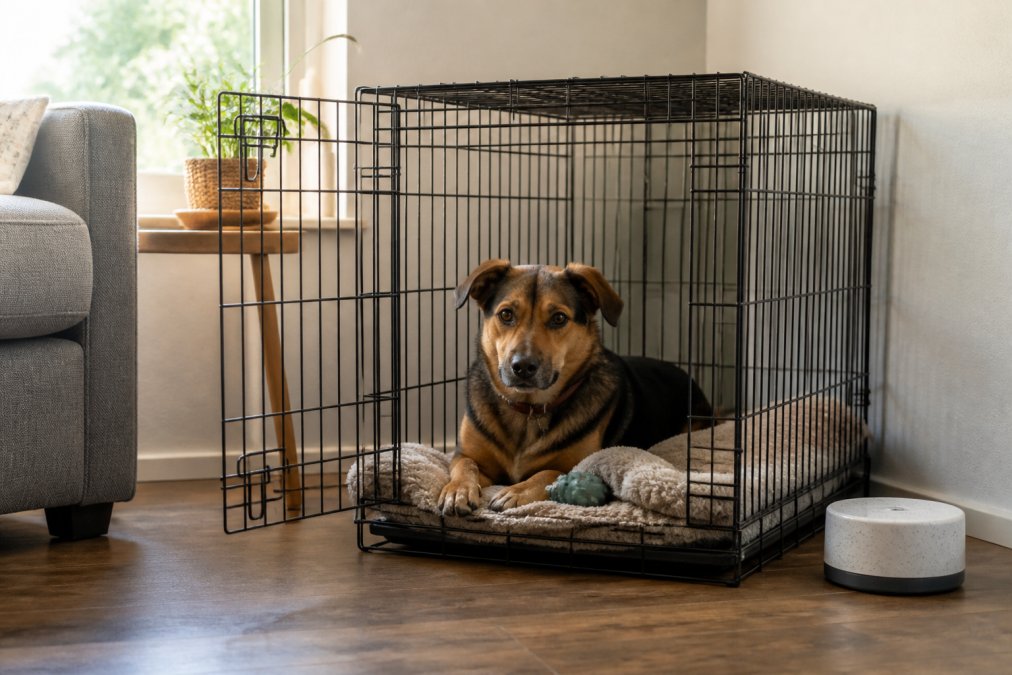
Crate Size, Placement, and Comfort Items
Crate size should let your dog stand, turn around, and lie flat without excess room. Too large and anxious dogs may eliminate in one corner and pace in the other; too small and confinement anxiety spikes.
Desensitization Exercises for Dogs Who Panic in the Crate
Desensitization exercises for dogs expose your dog to the trigger (your departure) at an intensity so low it produces no fear, then increase it in small increments. Pair each step with counter-conditioning: something your dog loves, delivered only during the exercise. The two must run together, desensitization without counter-conditioning only teaches tolerance, while counter-conditioning without desensitization teaches nothing because the fear never drops low enough to learn.
Start with the door open and no confinement at all:
- Toss a treat into the crate, let your dog walk in and out freely
- Close the door for one second, then open it and treat
- Close for three seconds, then five, then ten
- Step one foot away while the door is closed
- Step out of sight for two seconds, return, treat
- Build to leaving the room, then the house
A Day-by-Day Desensitization Schedule
What actually moves an anxious dog is a written schedule you can repeat and log, because progress here is measured in seconds, not sessions. The schedule below is a template, not a prescription, your dog's ceiling on any given day is whatever duration they can hold without crossing into stress signals.
| Day | Session Goal | Reps | Advance If | Hold If |
|---|---|---|---|---|
| 1 | Crate is a treat dispenser, door never closes | 10-15 | Dog enters voluntarily | Dog avoids crate |
| 2 | Door closed 1-3 seconds | 10 | No freezing or lip-licking | Any stress signal |
| 3 | Door closed 5-10 seconds | 8-10 | Dog stays oriented to you | Dog stares at door |
| 4 | Door closed 30 seconds, you sit nearby | 6 | Dog lies down or chews | Dog stands rigid |
| 5 | You stand up and sit back down | 6 | No rise in arousal | Whining starts |
| 6 | Step one foot away, return | 6 | Dog stays settled | Pacing begins |
| 7 | Step out of sight 2 seconds | 5 | Dog waits calmly | Barking or drooling |
| 8 | Out of sight 10 seconds | 5 | No vocalizing | Any vocalizing |
| 9 | Out of sight 30 seconds | 4 | Dog remains relaxed | Dog at door |
| 10 | Out of sight 1 minute | 4 | Calm on return | Escalation |
| 11 | Out of sight 3 minutes | 3 | No distress | Distress |
| 12 | Out of sight 5 minutes | 3 | Settles without you | Cannot settle |
| 13 | Out of sight 10 minutes | 2 | Calm throughout | Any panic sign |
| 14 | Out of sight 20-30 minutes | 2 | Passes twice in a row | Fails once |
Reading Your Dog's Threshold in Real Time
A threshold is the point just before fear kicks in. Stay under it, don't test it. Watch for these stress signals, in roughly the order they appear:
- Calming signals (green light): lip licking, yawning, turning the head away, soft blinking, sniffing the ground
- Early stress (yellow light): stiffening, freezing mid-motion, ears pinned back, whites of the eyes showing, tail tucked
- Full panic (red light): panting without heat, drooling, pacing, clawing at the door, vocalizing, attempting to climb the crate walls
Graduated Departure Protocol: 5 Seconds to 30 Minutes
The graduated departure protocol extends crate comfort into real alone time. Many trainers use a structured progression rather than guesswork, and the principle aligns with the fear-free handling approach promoted by the American Kennel Club (AKC crate training guidance).
| Stage | Duration Away | Goal Before Advancing |
|---|---|---|
| 1 | 5 seconds | Dog stays relaxed, no whining |
| 2 | 30 seconds | No pacing or drooling |
| 3 | 2 minutes | Settles without vocalizing |
| 4 | 10 minutes | Remains calm on return |
| 5 | 30 minutes | No escape behavior at any point |
Why Most Owners Stall at the Same Two Points
Two failure points show up again and again. The first is the door-close stage: owners close the door and walk away in the same rep, when the dog has never learned the closed door is temporary. Separate those variables, door closed with you present, then door closed with you stepping away, and the stall usually clears.
How Long Can a Dog With Anxiety Stay in a Crate?
How long a dog with anxiety can stay in a crate depends on age, bladder capacity, and emotional tolerance, and anxious dogs hit their limit far sooner than calm ones. A rough rule for healthy adult dogs is four to six hours maximum, with a midday break for anything longer; puppies need roughly one hour per month of age.
When Crating Isn't Working: Alternatives and Professional Help
Crating is the wrong tool for some dogs, and recognizing that early prevents injury and lasting fear. If weeks of incremental training produce no improvement, switch to environmental management instead of pushing harder.
Alternatives worth trying:
- A exercise pen that gives more room to move without full freedom
- Baby gates to confine your dog to a dog-proofed room
- A safe room with water, bedding, and enrichment toys
- Dog daycare or a boarding facility for days you are away long hours
Crate Safety and Injury Prevention for Anxious Dogs
Anxious dogs injure themselves in crates more often than calm dogs, so safety checks matter before every confinement. Remove collars and tags that can catch on bars, and inspect for sharp edges or bent wire.
Conclusion
Knowing how to crate train a dog with separation anxiety is a slow, deliberate process, and for some dogs it may never be the right fit. The dogs who struggle most are often the ones whose owners pushed past the threshold where fear begins.
Frequently Asked Questions
What is the 3-3-3 rule for dogs with anxiety?
The 3-3-3 rule describes a rescue dog's adjustment timeline: three days to decompress, three weeks to settle into a routine, and three months to feel fully at home. For crate training a dog with separation anxiety, this means expecting slow progress. Don't judge crate success on day two. Track small wins like lying down voluntarily, eating a treat inside, or staying quiet for 30 seconds. Rush the timeline and you'll trigger more panic responses, not fewer.
Is a crate actually good for a dog with separation anxiety?
It depends on the dog. A crate helps dogs who already see it as a safe space, but it makes things worse for dogs with confinement anxiety. Watch for escape behavior, drooling, pacing, or destructive chewing directed at the crate itself. Those are signs the crate is the problem, not the solution. In that case, switch to an exercise pen, a baby-gated room, or supervised daycare while you work on desensitization at a slower pace.
How do I calm my dog's anxiety when I leave?
Build a predictable exit routine and practice it in tiny doses. Pick up your keys, then sit back down. Put on shoes, then make coffee. Repeat until these cues stop triggering a panic response. Pair departures with a frozen stuffed toy or long-lasting chew so the crate predicts something good. Keep goodbyes short and low-key. A drawn-out emotional exit teaches your dog that leaving is a big deal, which raises anxiety instead of lowering it.
What can I do to help my rescue dog with severe separation anxiety?
Start with a veterinary assessment to rule out medical causes and discuss whether anti-anxiety medication is appropriate. Then work with a certified professional behaviorist on a behavior modification plan that combines desensitization, counter-conditioning, and environmental management. For dogs who can't be left alone safely, structured daycare or boarding with 24/7 supervised staff gives them company while you build tolerance at home. Severe cases rarely resolve with crate training alone.