 how-to
How to Find Boarding for Aggressive Dogs: A 2026 Guide
Table of Contents
- Why Standard Boarding Facilities Turn Away Aggressive Dogs
- Reactive vs. Aggressive: What Boarding for Aggressive Dogs Actually Requires
- Questions to Ask Boarding Facilities for Aggressive Dogs
- What a Dog Boarding Temperament Assessment Involves
- How to Prepare a Reactive Dog for Boarding
- Private vs. Group Boarding: A Cost-Benefit Look
- On-Site Visit Checklist for Boarding for Aggressive Dogs
- Frequently Asked Questions
Last Updated: September 12, 2026
Why Standard Boarding Facilities Turn Away Aggressive Dogs
Finding boarding for aggressive dogs starts with understanding why most kennels say no. Standard facilities rely on group play and shared spaces, which creates real liability when a dog has a bite history or severe reactivity.
Kennel stress makes everything worse: an anxious or fear-reactive dog can escalate quickly in a loud, crowded environment (avma.org). Facilities that accept these dogs have private runs, trained handlers, and clear safety protocols rather than open-floor play.
Reactive vs. Aggressive: What Boarding for Aggressive Dogs Actually Requires
Reactive and aggressive are not the same thing, and boarding for aggressive dogs depends on knowing which one you're dealing with. A reactive dog overreacts to a trigger, like another dog on a leash, but recovers once it's gone. An aggressive dog may escalate to a bite without recovery.
The distinction shapes the care plan. Reactive dogs often do well with trigger management, space, and low-stimulation routines; dogs with a bite history need containment, muzzle protocols, and one-on-one handling. Don't assume "reactive" means "aggressive" and give up on boarding, the right facility can often accommodate a reactive dog.
Questions to Ask Boarding Facilities for Aggressive Dogs
Before you book, ask direct questions. Vague answers are a red flag. A facility that genuinely handles aggressive dogs will have specific, practiced answers about staffing, safety, and daily structure.
Safety, Staffing, and Emergency Preparedness Questions
Staff-to-dog ratios matter more than almost anything else. Ask how many staff are on-site overnight, whether anyone is present 24/7, and how the facility separates dogs that can't be around others. Confirm the containment plan for escapes or altercations, and what happens if your dog is injured at 2 a.m.
- Is there 24/7 on-site supervision, or is staff only present during daytime hours?
- What is the staff-to-dog ratio, and are handlers trained in fear-based aggression and resource guarding?
- How are aggressive dogs separated from the general population?
- What is the written emergency contingency plan, and which vet is on call?
Medication, Containment, and Daily Routine Questions
If your dog takes medication, ask exactly how doses are logged and administered. Get the daily routine in writing: feeding times, potty breaks, exercise, and rest. For separation anxiety, ask whether private runs are available so your dog isn't staring at other dogs all day.
What a Dog Boarding Temperament Assessment Involves
A dog boarding temperament assessment is a structured evaluation of how your dog behaves around other animals, unfamiliar people, and new environments. It's not a pass/fail judgment on your dog's character; it's a safety tool that determines the right level of individualized care. For aggressive dogs, it's also where the facility decides whether it can safely meet your dog's needs, and where you decide whether its protocols are strong enough to trust.
What Happens During the Pre-Boarding Evaluation
Most reputable facilities run a pre-boarding evaluation before confirming a stay. Expect a meet-and-greet, observation of your dog's body language, and questions about triggers, bite history, and past boarding experiences. Some use a controlled introduction to other dogs; others keep aggressive dogs separate from the start.
The evaluation usually covers:
- Reaction to strangers and handling
- Response to other dogs at a distance and up close
- Resource guarding around food, toys, or beds
- Response to common stressors like crates, noise, and confinement
Be honest. The evaluation only works if staff know your dog's real triggers.
How a Real Assessment Is Structured
A thorough evaluation is not a five-minute lobby greeting. Watch for these stages:
- Intake interview. Staff document bite history, known triggers, prior training, current medications, and baseline behavior at home. Bring written notes, memory fades under stress.
- Leash and handling test. A handler observes how your dog responds to a stranger taking the leash, approaching the kennel, and performing a basic body check (ears, paws, muzzle area).
- Barrier and distance observation. Your dog is observed behind a gate or fence while another dog passes at a distance. This reveals reactivity without putting anyone at risk.
- Controlled parallel walk or side-by-side exposure. Only if the earlier stages are clean. Many facilities skip this entirely for dogs with a bite history, that's a sign of competence, not laziness.
- Kennel acclimation trial. Your dog is placed in the actual run or suite it would use, and staff note how quickly it settles.
Medication and Medical Intake
Many aggressive or reactive dogs take daily medication, fluoxetine, trazodone, gabapentin, or clomipramine are common for anxiety and reactivity (vcahospitals.com). A facility that accepts these dogs must have a written medication protocol, not a verbal promise. Ask:
- Who administers doses, and is that person trained to recognize adverse reactions?
- How are doses logged, and will you receive a record at pickup?
- What happens if a dose is missed or refused?
- Can the facility handle injectables or compounded medications, or only pills?
General kennels often accept a pill in a treat but have no logging system and no plan for a dog that refuses food. That gap is where medical errors happen.
Emergency Contingency Planning
Owners of aggressive dogs worry most about bite incidents. A prepared facility will have answers ready before you ask:
- Bite protocol. Written steps for separating animals, securing the injured party, and documenting the incident.
- On-call veterinarian. The name and 24-hour number of the vet who will see your dog, plus the nearest emergency animal hospital.
- Owner notification timeline. How quickly you'll be contacted, and through what channel.
- Insurance and liability. Whether the facility carries coverage for handling aggressive animals, and what your signed waiver actually releases them from.
What a Good Outcome Looks Like
A successful assessment ends with a clear placement decision: private run, one-on-one handling, muzzle protocol, or a polite decline. If a facility accepts every dog that walks in, that's not flexibility, it's a warning sign. The best facilities turn away dogs they can't safely manage, and tell you why.
How to Prepare a Reactive Dog for Boarding
Preparation starts weeks before drop-off. A reactive dog who has never been away from home will struggle in any facility, no matter how good it is. The goal is to reduce novelty and build positive associations.
Trial Stays, Muzzle Training, and Stress Reduction Basics
Book a short trial stay, even one night, so your dog experiences the environment without a long separation. If your dog has any bite risk, start muzzle training at home with positive reinforcement: reward the muzzle for seconds, then minutes, then during short outings. A dog comfortable in a muzzle is safer for handlers and less stressed.
Bring familiar items: a worn t-shirt, your dog's usual food, and a favorite toy. Stick to your normal feeding and walking schedule before drop-off, and avoid a big emotional goodbye, which spikes anxiety.
The single biggest predictor of a smooth boarding stay is preparation done at home, not the facility's amenities. Trial stays and muzzle training reduce stress far more than a nicer lobby ever will.
Private vs. Group Boarding: A Cost-Benefit Look
Private boarding costs more than group boarding, and for aggressive dogs it's usually the only safe option. Group play is cheaper because facilities spread staff across many dogs at once; private runs require dedicated handling, one-on-one time, and separate containment.
The trade-off isn't just price. For a dog with aggression triggers, group boarding can undo months of behavioral modification work and put other dogs at risk. Private boarding with individualized care protects your dog and everyone around them. When comparing facilities, ask what's included in the private rate: potty breaks, one-on-one time, and medication administration.
What Actually Drives the Price Difference
Group boarding is inexpensive because one handler can supervise a dozen dogs in a shared yard. Private boarding inverts that math: a single handler can only manage one or two aggressive dogs at a time, and every interaction, feeding, potty breaks, exercise, medication, happens in isolation with safety equipment on hand.
The cost gap usually comes down to four variables:
- Staff-to-dog ratio. Group play might run 1:10 or higher. Aggressive-dog care typically runs 1:1 or 1:2.
- Containment infrastructure. Double-gated runs, solid barriers between kennels, and lock systems cost more to build and maintain than open play yards.
- Handling time. A private dog needs leashed potty breaks, structured exercise, and enrichment, all delivered one-on-one.
- Medication and medical oversight. Logged dosing, behavioral observation, and vet coordination add labor that group boarding doesn't require.
The Hidden Cost of Choosing Group Boarding for an Aggressive Dog
The sticker price of group boarding looks attractive until you price out what can go wrong:
- Behavioral regression. Months of counter-conditioning work can unravel in a single stressful group session. Retraining costs far more than the boarding savings.
- Injury liability. If your dog bites another boarder, you may be responsible for the other dog's veterinary bills, and your own dog's quarantine or euthanasia risk depending on local animal control rules (avma.org).
- Emergency relocation. A facility that discovers your dog's triggers mid-stay can terminate the booking, leaving you to find last-minute care, often at premium rates.
- Medical setbacks. A dog that refuses food or medication in a high-stress group environment can decompensate quickly.
How to Evaluate Whether a Private Rate Is Fair
Don't compare private rates by dollar figure alone, compare what's bundled. Two facilities can quote very different nightly rates and deliver very different value. Ask each one:
- How many one-on-one sessions per day, and how long is each?
- How many potty breaks, and are they leashed and supervised?
- Is medication administration included, or billed as an add-on?
- Is there a separate enrichment or training add-on, and what does it include?
- What is the cancellation and early-pickup policy if your dog doesn't settle?
A higher rate that includes three supervised one-on-one sessions, logged medication, and structured enrichment is often cheaper per unit of actual care than a lower rate that charges for each separately.
| Boarding Type | Best For | Key Trade-Off |
|---|---|---|
| Private run | Aggressive or reactive dogs, medication needs | Higher cost, less social contact |
| Group play | Social, non-reactive dogs | Lower cost, higher stress for reactive dogs |
| Trial stay | First-time boarders, any temperament | Short duration, builds familiarity |
For an aggressive dog, the right question is not "which facility is cheapest" but "which facility's private-care rate includes the handling, medication oversight, and safety protocols my dog actually needs." A low rate that excludes those items is not a bargain, it's a liability.
A Note on Board-and-Train
Some facilities bundle boarding with behavioral training, often called board-and-train. For aggressive dogs, this can be a strong option because the dog receives structured daily work rather than just containment. Ask whether the trainer uses aversive tools or force-free methods, how many training sessions happen per day, and whether you get a handoff session at pickup so progress carries home. Board-and-train is typically priced higher than standard private boarding because you're paying for trainer time, not just kennel space.
On-Site Visit Checklist for Boarding for Aggressive Dogs
Tour the facility before you commit. A site visit tells you more than any phone call. Look at the runs, fencing, cleanliness, and how staff interact with the dogs already there. Ask to see where your dog would stay.
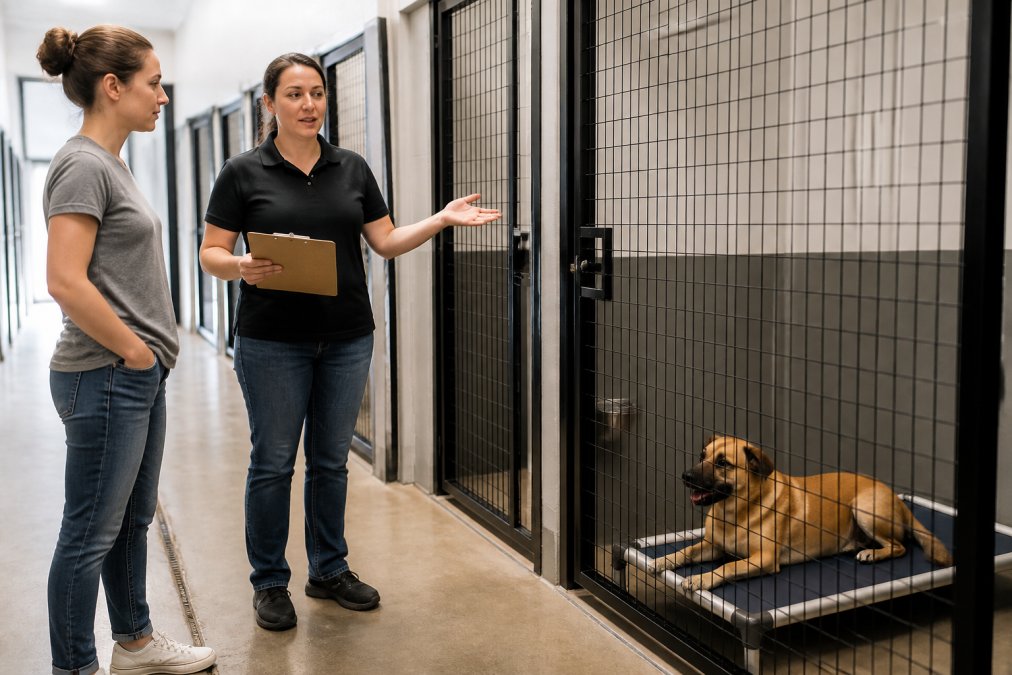
- Private runs are available and securely gated
- Staff are on-site 24/7, not just during the day
- Medication administration is logged and documented
- Emergency vet contact and contingency plan are in writing
- Vaccination requirements (including kennel cough) are clearly stated
- Dogs are separated by temperament, not just size
- You can request photo or video updates during the stay
A facility that hesitates on any of these is worth a second look, or a pass.
Boarding a dog with aggression or reactivity takes more legwork than booking a standard kennel, but it's far from impossible when you know what to ask. Ruffin' It Ranch is equipped to care for puppies and aggressive pups with 24/7 on-site professional staff, spacious private indoor and outdoor runs, and individualized care tailored to each dog's needs. If your dog needs a private run, or a calm, climate-controlled environment, our team can help. Book your pet's stay now and travel with peace of mind.
Frequently Asked Questions
Can an aggressive dog be boarded at a standard kennel?
Most standard kennels cannot safely board aggressive dogs because they rely on group play and open-floor designs. Facilities equipped for boarding for aggressive dogs use private runs, staff-to-dog ratios built for one-on-one handling, and written safety protocols. If a kennel says yes without asking about your dog's triggers, bite history, or medication needs, that is a warning sign, not a green light. Look for a facility that requires a temperament assessment first.
Should I disclose my dog's aggression to a boarding facility?
Yes, always. Withholding bite history, aggression triggers, or resource guarding puts staff and other dogs at risk and can void a liability waiver. Reputable facilities ask detailed questions during intake and use that information to build an individualized care plan. Disclosing also protects your dog: staff who know about leash reactivity or fear-based aggression can adjust handling, avoid trigger stacking, and reduce kennel stress during the stay.
How do I prepare a reactive dog for boarding?
Start weeks ahead. Book a trial stay so your dog experiences the facility briefly before a long visit. Practice calm crate or run time at home, keep vaccination requirements current, and pack familiar items like a worn t-shirt or favorite toy. If your dog is muzzle-trained, bring the muzzle so staff can use it during handling if needed. Share a written routine covering feeding, medication administration, and known aggression triggers.
What should I look for during a facility site visit?
Ask to see the actual runs, not just the lobby. Check for secure containment, double-gate entries, 24/7 supervision, and a climate-controlled environment. Confirm how staff handle emergency contingency plans, including which vet they call and how they reach you. Ask about staff training, staff-to-dog ratios, and whether group play is ever mixed with private care. A facility comfortable with boarding for aggressive dogs will answer these questions directly and show you the spaces.