 how-to
Safe Socialization for Rescue Dogs: A Step-by-Step Guide
Table of Contents
- Understanding Your Rescue Dog's Background and Body Language
- The 3-3-3 Rule for Rescue Dogs: A Timeline for Adjustment
- Recognizing Signs of Dog Anxiety During Socialization
- How to Introduce Dogs Safely: Step-by-Step
- Safe Socialization for Rescue Dogs: Core Principles and Techniques
- Decompression and Downtime: The Missing Piece in Rescue Dog Socialization
- When to Seek Professional Help for Your Rescue Dog
- Conclusion: Patience and Consistency Build Trust
- Frequently Asked Questions
Last Updated: September 17, 2026
Understanding Your Rescue Dog's Background and Body Language
Safe socialization for rescue dogs starts with reading what the dog is telling you before you introduce a single new person or place. Rescue dogs arrive with unknown histories, and their body language is the most reliable information you have. This guide walks through a structured, step-by-step approach built around that principle.
The 3-3-3 Rule for Rescue Dogs: A Timeline for Adjustment
The 3-3-3 rule for rescue dogs describes three phases: three days to decompress, three weeks to settle into routine, and three months to feel fully at home. It is a useful benchmark, not a rigid schedule, since every dog moves at its own pace.
Recognizing Signs of Dog Anxiety During Socialization
Signs of dog anxiety show up long before a growl or snap. Catching them early lets you create distance before the dog crosses its threshold, the point where stress turns into a reaction.
Watch for:
- Avoidance behavior: turning away, hiding behind your legs, trying to leave
- Stress signals: panting without exercise, yawning, excessive shedding, pacing
- Freezing or stiffening when approached
- Trigger stacking: several small stressors piling up in one outing until the dog tips over
How to Introduce Dogs Safely: Step-by-Step
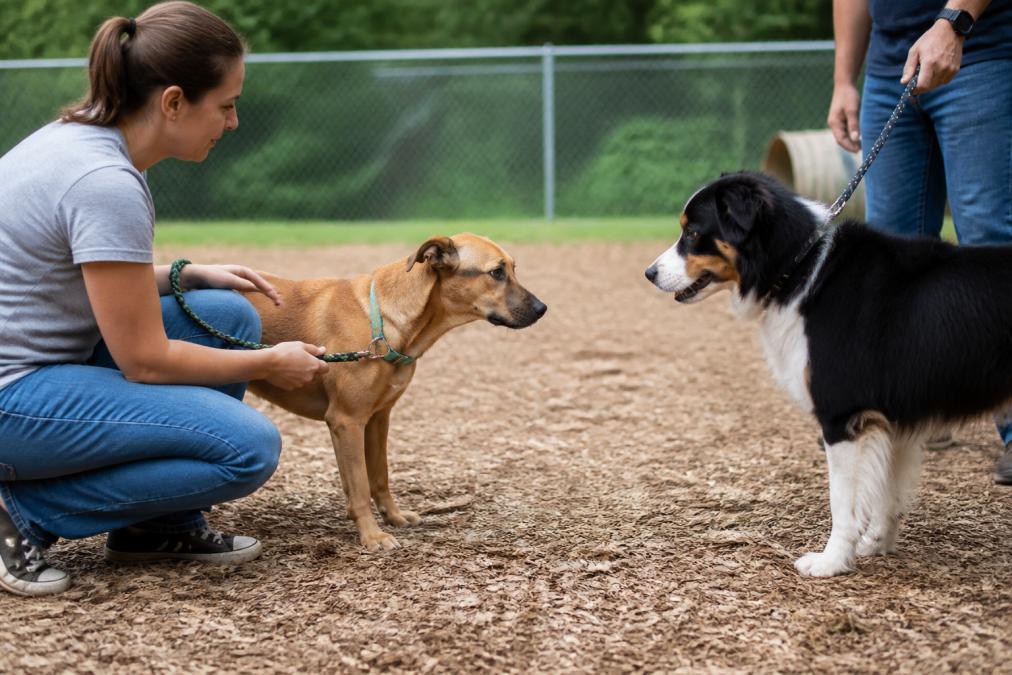
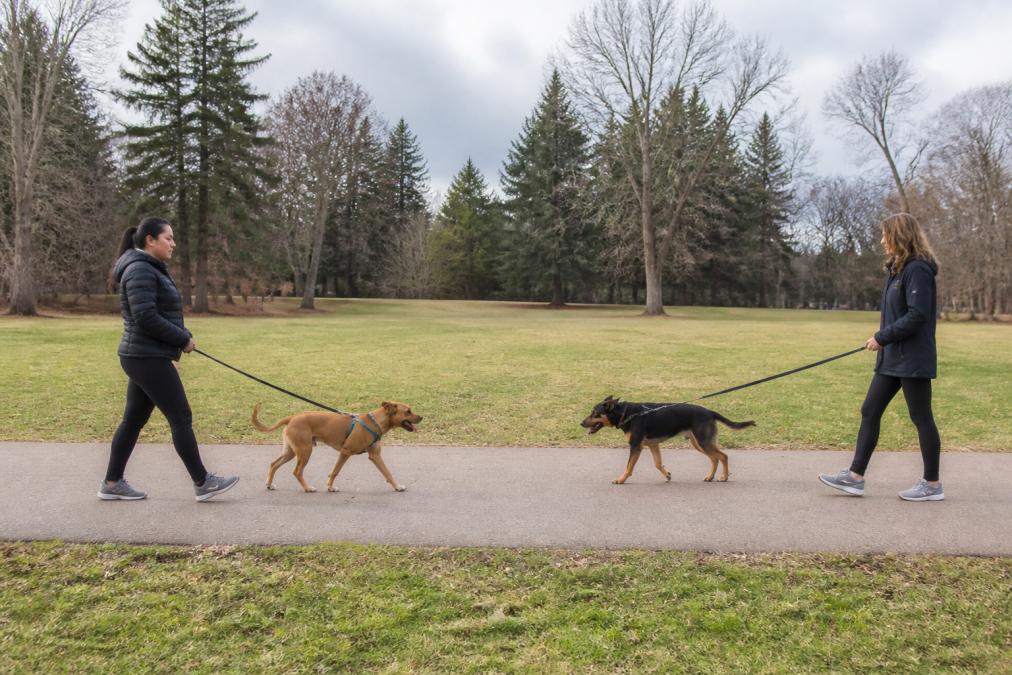
How to introduce dogs safely comes down to distance, calm handling, and never forcing contact. A parallel walk at a comfortable distance is the safest first step, not a face-to-face greeting. The goal is not a playdate. The goal is neutrality, two dogs who can exist in the same space without fixating, lunging, or shutting down.
Equipment that keeps the session safe
Before the first meeting, set up gear that gives you control without adding tension:
- A well-fitted Y-front or H-back harness distributes pressure across the chest instead of the throat. A dog that pulls into a neck-only collar can damage the trachea and will read the pressure as a correction, which spikes arousal.
- A 6-foot leash for greetings, a 15- to 30-foot long line for distance work. Long lines let the dog move away from a trigger without hitting the end of a short leash. Never use a retractable leash for this work, the constant tension teaches the dog that pressure is normal.
- A basket muzzle, conditioned with treats beforehand, for any dog with a bite history or unknown history. A muzzled dog can still pant, drink, and take treats. Muzzle training is a welfare tool, not a punishment, and it lets a dog participate in walks that would otherwise be off-limits.
- Two handlers, one per dog. One person handling two dogs cannot read both sets of body language at once.
The parallel walk, step by step
- Start at a distance. Walk both dogs in the same direction, far enough apart that neither fixates on the other. A common starting point is across a wide street or on opposite sides of a park path, far enough that both dogs can look at each other and then look away.
- Keep leashes loose. A tight leash signals tension down the line and can trigger leash reactivity. If the leash is taut, you are too close.
- Watch for loose, relaxed body language before closing any gap. Curved approaches beat head-on greetings. A head-on, straight-line approach reads as a challenge to many dogs.
- Shorten the distance gradually across several sessions, not within one walk. If either dog stiffens, turns away, or freezes, add distance immediately and end the approach.
- End on a good note. Stop while both dogs are still calm, not after a reaction. A session that ends at a 7 out of 10 on the arousal scale teaches the dog that other dogs predict stress.
Respect each dog's proximity boundary. That boundary is the distance at which the dog first notices the other dog but can still take a treat and respond to its name. Work just inside that distance, never past it.
Introducing a new rescue to resident dogs
Multi-dog households need a slower sequence than a one-off park walk:
- Keep them separated for the first few days. The new dog gets its own room, baby gate, or crate-and-pen setup. Resident dogs get the rest of the house. They can smell and hear each other through the barrier without meeting.
- Swap bedding and rotate rooms so each dog learns the other's scent before any visual introduction.
- First visual contact through a barrier. A baby gate or a glass door at a distance both dogs can handle. Reward calm behavior on both sides.
- Parallel walks with two handlers, as above, before any off-leash time.
- Short, supervised introductions in a neutral space, not the resident dog's favorite couch or the new dog's safe room. Neutral ground reduces territorial pressure.
- Separate for meals, chews, and toys until you have weeks of calm, uneventful contact. Resource guarding is one of the most common reasons multi-dog placements fail.
Safe Socialization for Rescue Dogs: Core Principles and Techniques
Safe socialization for rescue dogs rests on positive reinforcement, counter-conditioning, and desensitization. Pairing a scary trigger with high-value treats teaches the dog that the trigger predicts something good, not something to fear.
Decompression and Downtime: The Missing Piece in Rescue Dog Socialization
Decompression is the structured rest period a rescue dog needs between stressful events, and it is the step most owners skip. Without it, a dog that seems to be "handling things fine" can tip into trigger stacking days later.
When to Seek Professional Help for Your Rescue Dog
Professional help is warranted when a dog shows repeated growling, snapping, or biting, or when fear-based behavior does not improve after weeks of consistent, reward-based work. But before you book anyone, check whether the dog has actually had a decompression period first. A rescue dog that is still in the first three weeks post-adoption is not a training problem, it is a dog that has not settled yet.
The neutrality reframe
Most owners come to this work wanting their rescue dog to make friends. That is the wrong goal for a fearful or reactive dog, and it is the single biggest reason socialization attempts fail. Neutrality, the ability to notice another dog or person, register them as unremarkable, and move on, is the realistic and safe target. Friendship may come later.
Red flags that call for a referral
- Bites that break skin or leave bruising
- Reactivity that escalates despite managed exposure and a completed decompression period
- Sudden behavior changes in an adult dog, especially in a dog over 7 or one with no prior history
- Fear that interferes with eating, sleeping, or basic daily function
- Any behavior that puts a child, a resident dog, or a visitor at risk
Who to call, and what to ask
There are two distinct credentials, and they are not interchangeable:
- A certified applied animal behaviorist or veterinary behaviorist handles clinical cases, severe fear, aggression, compulsive disorders, and cases where medication may be part of the plan. Veterinary behaviorists are licensed veterinarians with additional behavior training, so they can rule out pain, thyroid issues, and other medical causes that mimic behavior problems.
- A certified professional trainer using reward-based methods is the right fit for foundational work: loose-leash walking, threshold management, crate training, and structured socialization sessions.
Where structured environments fit
Boarding and daycare environments can support this work when they are structured around it rather than around forced interaction. Ruffin' It Ranch offers private and open play sessions, 24/7 on-site staff, and individualized care for dogs with special needs, which can provide a controlled setting to practice neutrality rather than forced interaction. The right environment is one where a dog can opt out of contact, a private run, a quiet walk, a one-on-one session, and where staff are trained to read stress signals rather than wait for a reaction.
Conclusion: Patience and Consistency Build Trust
The hardest part of socializing a rescue dog is resisting the urge to move faster than the dog can handle. Progress is measured in small, repeatable wins: a calm walk past a stranger, a relaxed greeting, a night without pacing.
Frequently Asked Questions
What is the 3-3-3 rule for rescue dogs?
The 3-3-3 rule is a guideline for understanding a rescue dog's adjustment period. The first 3 days are for decompression, where the dog may feel overwhelmed and shut down. The next 3 weeks involve settling in and learning your routine. After 3 months, the dog typically feels secure and shows their true personality. This timeline helps set realistic expectations for safe socialization for rescue dogs.
How can I tell if my rescue dog is overwhelmed during socialization?
Watch for signs of dog anxiety such as lip licking, yawning, whale eye (showing the whites of the eyes), tucked tail, flattened ears, and trying to hide or pull away. These are calming signals that indicate stress. If you see these, increase distance from the trigger and give your dog space. Never force interaction; instead, reward calm behavior and allow your dog to opt out.
How do I introduce my rescue dog to new people safely?
Start with parallel walks or meet in a neutral, quiet area. Ask the person to avoid direct eye contact, towering over the dog, or reaching out. Let the dog approach first. Toss high-value treats to create positive associations. Keep initial meetings short, under 5 minutes, and end on a positive note. Repeat these structured exposures until your dog shows relaxed body language.
Is it ever too late to socialize an adult rescue dog?
No, it's never too late. While the socialization window closes around 16 weeks, adult dogs can still learn and build confidence through behavior modification techniques like desensitization and counter-conditioning. The key is to go at your dog's pace, use positive reinforcement, and focus on neutrality rather than forced friendliness. Professional trainers can help create a customized plan.