 how-to
How to Choose a Pet Resort for Puppies: 7-Step Guide
Table of Contents
- Start With the Right Puppy Boarding Age
- Evaluate the Facility: Licensing, Cleanliness, and Supervision
- Questions to Ask a Dog Boarding Facility Before You Book
- Match Play Groups and Accommodations to Puppy Behavior
- Build Your Puppy Boarding Checklist
- How to Prepare a Puppy for Boarding: A Trial-Stay Plan
- Spotting and Handling Puppy Stress at a Pet Resort for Puppies
- Frequently Asked Questions
Last Updated: October 20, 2026
Start With the Right Puppy Boarding Age
Most pet resort for puppies facilities take puppies once they're fully vaccinated, and that timing matters.
The right age depends on three things: vaccine completion, your vet's sign-off, and the puppy's ability to handle a routine change. Boarding before that point puts them at real risk.
Vaccine Timing That Decides When Your Puppy Can Board
Puppies need their full core vaccine series before group boarding, typically the final round at 16 weeks or later. Many facilities also require proof of rabies vaccination, usually given at 12 to 16 weeks.
Ask for these records in writing:
- DHPP (distemper, hepatitis, parainfluenza, parvovirus) completion date
- Rabies certificate with the date given
- Bordetella (kennel cough) vaccine, often required every 6 to 12 months
The American Veterinary Medical Association's vaccination guidelines explain why puppies shouldn't mix with unknown dogs until their series is complete.
Development Stages and What They Mean for Group Play
A 12-week-old puppy and a 7-month-old are not the same animal. Young puppies tire fast and need quiet naps; older puppies play harder and can bowl over a smaller pup without meaning to.
Ask how the facility separates puppies by size, age, and energy level. A specific answer is good; a vague one is a red flag.
Evaluate the Facility: Licensing, Cleanliness, and Supervision
A boarding facility is only as good as what you can verify in person. Licensing, cleaning routines, and staff supervision are the three things you can actually check, skip any and you're guessing.
What a Facility Tour Should Actually Reveal
A real tour walks you through the whole building, not just the lobby: kennels, play areas, food prep space, and outdoor runs.
Watch for these during your visit:
- Smell: A clean facility smells clean, not like disinfectant covering something else
- Surfaces: Floors should be dry, and bedding should look fresh
- Water: Every run should have clean, full water bowls
Ask how often kennels get deep-cleaned. Daily spot cleaning plus regular deep cleaning is standard. If staff can't answer, walk away.
Staff Training, Ratios, and Overnight Coverage
Ask how many dogs each staff member watches at once, smaller groups mean more attention per puppy, and what training staff receive in dog body language and behavior.
Overnight coverage is the question most owners forget. Are staff on-site all night or checking in remotely? For a puppy, on-site care is safer, they wake up, need bathroom breaks, and can get scared alone.
Questions to Ask a Dog Boarding Facility Before You Book
Bring a written list of questions to every tour, the answers tell you more than the brochure. Here are the ones that matter most for a puppy.
Health and safety:
- What are your vaccination requirements, and how do you verify them?
- What happens if my puppy gets sick or hurt?
- Which veterinarian do you call, and how fast can they get here?
Daily life:
- How many play sessions does a puppy get each day?
- How do you match puppies for group play?
- What's the staff-to-puppy ratio during play and overnight?
Policies:
- What's your cancellation policy?
- Do you require a trial stay before a longer booking?
- What's included in the rate, and what costs extra?
Write down the answers and compare across facilities. The one that answers clearly and specifically usually runs a tighter operation.
Match Play Groups and Accommodations to Puppy Behavior
Not every puppy belongs in open group play, and that's fine. The difference between a good resort and a great one is whether staff can explain specifically how they group puppies, how introductions happen, and what happens when a puppy needs a break. Vague answers like "we just watch them" are a red flag.
Age- and Size-Matched Play Groups
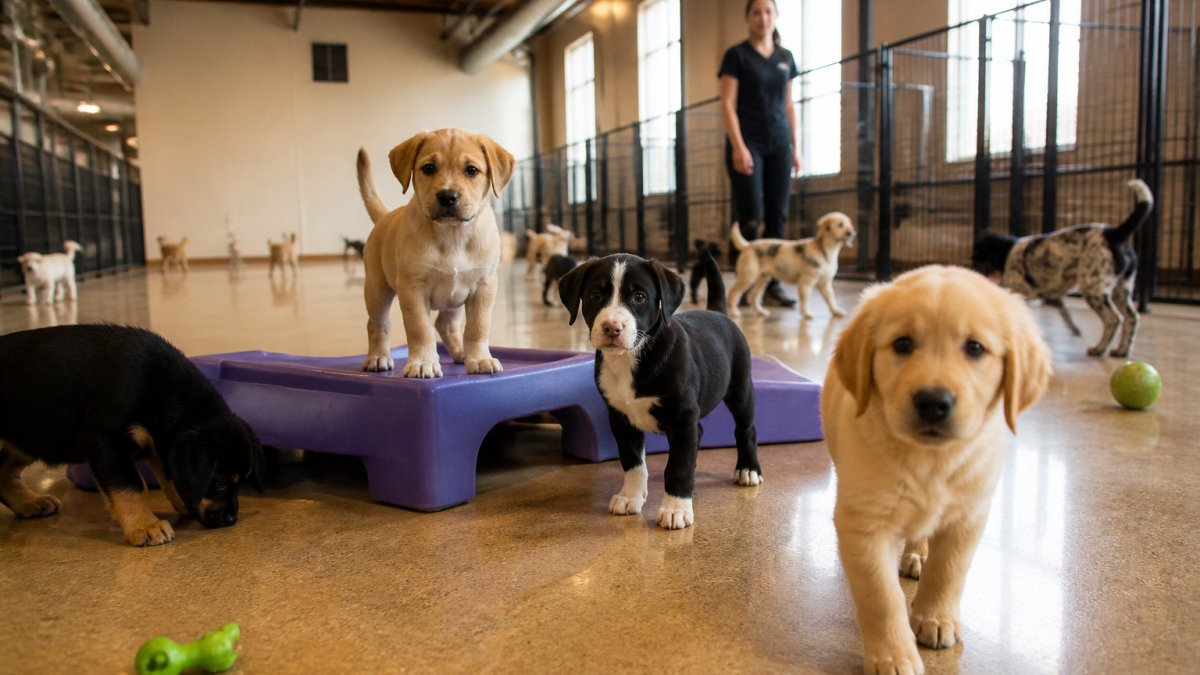
Puppies under 6 months are still learning bite inhibition, body awareness, and how to read other dogs' signals. A 10-pound puppy in a group of 40-pound adolescents is a recipe for fear or injury. Ask the facility to describe its grouping criteria out loud:
- Age bands: Are puppies under 6 months kept with other young puppies, or mixed with adult dogs?
- Size bands: Is there a weight cutoff (for example, under 25 pounds versus over 25 pounds) for play groups?
- Energy matching: Are high-drive puppies separated from low-key ones, or is everyone thrown together?
A good answer sounds specific: "We group puppies under 6 months with other young dogs, keep groups under 10, and rotate puppies out for rest every 20 to 30 minutes."
Staff-Supervised Introductions
Puppies should not be dropped into a play yard and left to sort it out. Ask how introductions work, a common pattern is a brief one-on-one assessment with a calm, vaccinated adult or a confident puppy of similar size, then a short supervised session before any larger group. Staff should describe what they watch for: loose body language, play bows, reciprocal chasing, and pauses.
Rest Breaks and Downtime
Puppies tire fast and get cranky when overtired, just like toddlers. Ask how many play sessions a puppy gets per day and how long each lasts. A reasonable pattern is two to four short sessions (15 to 30 minutes) with enforced nap breaks, not hours of unstructured yard time, overtired puppies play rougher and are more likely to snap or get snapped at.
Alternatives for Puppies Not Ready for Group Play
Shy, very young, or recovering puppies do better with private play or one-on-one time with staff. Ask whether the facility offers:
- Private play sessions with a staff member and a toy or flirt pole
- Parallel play with a calm dog behind a barrier, so the puppy can practice being near other dogs without pressure
- Solo enrichment such as puzzle feeders, snuffle mats, or a frozen stuffed toy in the kennel
A resort that only offers open group play is not the right fit for every puppy, and a good facility will say so.
Accommodations That Fit a Puppy
Accommodations should fit the puppy, not just the building. Look for:
- Kennel size that lets the puppy stand, turn, and stretch out fully
- Private runs for puppies who get stressed by noise or other dogs
- Bedding that's clean, washable, and changed between guests
At Ruffin' It Ranch, we offer both private and open play sessions, so a nervous puppy isn't forced into a group before they're ready. Our runs are spacious and climate-controlled.
Build Your Puppy Boarding Checklist
Use this checklist before you book any facility to avoid forgetting the details that matter most.
- Vaccine records in hand, including rabies and bordetella
- Written vet clearance for boarding
- Confirmed age and weight requirements
How to Prepare a Puppy for Boarding: A Trial-Stay Plan
A trial stay is a short practice run, usually one night, that lets your puppy adjust before a longer booking and catches problems early.
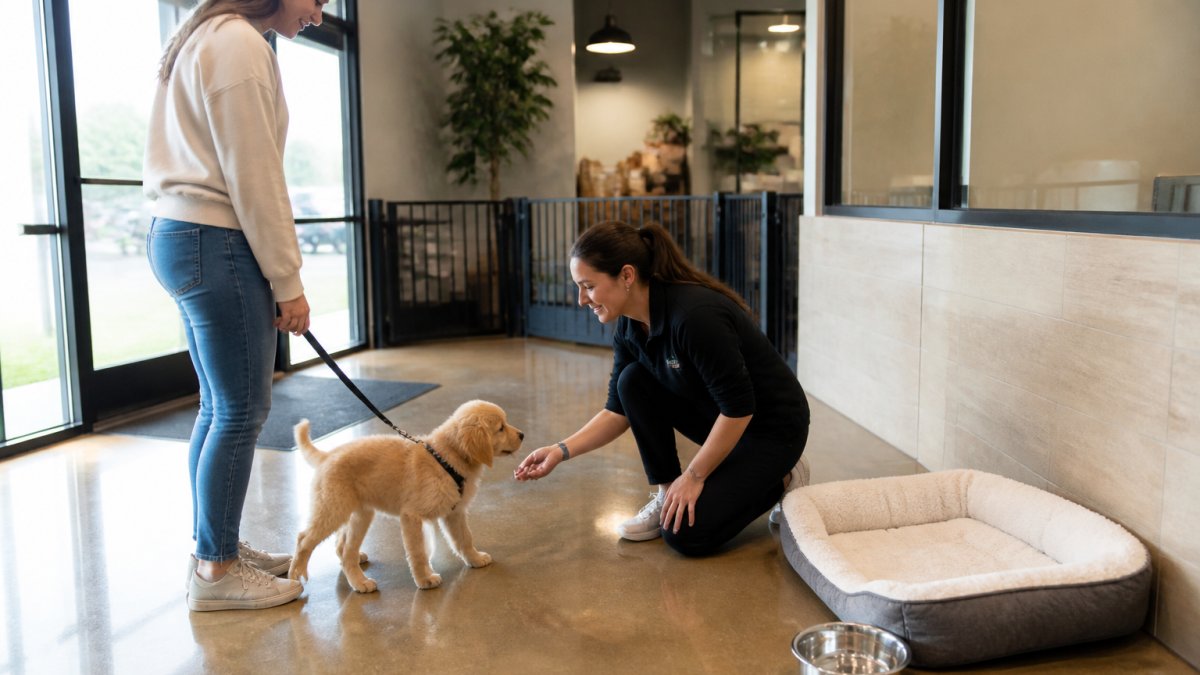
Start with a short visit, then a day of daycare, then one overnight, spaced over a few weeks so your puppy isn't overwhelmed. Bring their own food, a familiar blanket, and a toy that smells like home.
Sleep, Feeding, and Toileting Schedules to Share
Write out your puppy's daily routine and hand it to staff, puppies do better when their schedule stays close to home.
Include these details:
- Feeding: exact food, amount, and times
- Toileting: how often, and any cues your puppy uses
- Naps: when your puppy usually sleeps and for how long
Small things matter. If your puppy eats at 7 a.m. and 5 p.m., say so. If they need a bathroom break right after eating, say that too.
Spotting and Handling Puppy Stress at a Pet Resort for Puppies
Stress looks different in puppies than in adult dogs, and the first 24 hours at any facility are an adjustment for almost every puppy. The question is whether the facility can tell normal settling from real distress, and has a plan for both.
Normal Adjustment vs. Distress
Some first-day stress is normal: pacing, brief whining, or skipping a meal. What matters is whether those signs fade as the puppy settles in, restless for a few hours, then eating, napping, and engaging by the next play session. Distress that continues past 24 hours, or escalates, needs attention.
Observable Signs to Ask About
Ask staff what they actually watch for. A good answer includes specific, observable behaviors, not vague assurances:
- Appetite: Is the puppy eating and drinking normally, or refusing food?
- Elimination: Are stools normal, or loose from stress?
- Body language: Is the puppy tucked, hiding, trembling, or panting when it's not hot?
A facility that brushes off stress as "normal" without describing how they monitor it isn't paying close enough attention. Puppies can't tell you what's wrong, so staff have to notice for them.
How Good Facilities Respond
Ask the facility to walk you through what happens when a puppy shows stress. Strong answers include:
- Moving the puppy to a quieter, private space away from noise and other dogs
- Extra one-on-one time with a staff member, including calm handling and quiet play
- Keeping the puppy's own food, blanket, and toy nearby for familiarity
A facility that has a written protocol for stress is more reliable than one that improvises.
Communication With Owners
Ask how and when the facility contacts you. A good policy is a check-in within the first few hours, a photo or update at least once a day, and an immediate call if the puppy stops eating, has loose stools, or shows signs of illness or injury. Ask whether you can call to check in and whether staff give an honest report rather than a polished one.
When to Reconsider the Setting
If a puppy shows severe distress, persistent refusal to eat, continuous vocalization, or signs of illness, the right move may be a different setting.
At Ruffin' It Ranch, our team cares for puppies and dogs with special needs, and we offer private or open play so each puppy gets the right level of social time.
Frequently Asked Questions
What is the best age to board a puppy for the first time?
Most puppies are ready for their first boarding stay once they have completed their core vaccine series, which typically happens around 16 weeks. Before that, a facility may require proof of vaccination and a negative health check. Some resorts accept younger puppies in separate, low-contact areas, but group play should wait until immunity is established. Ask about puppy boarding age policies before booking so you know exactly when your puppy qualifies and what records you need to provide.
What vaccinations does a puppy need before staying at a pet resort?
Expect a boarding facility to require proof of rabies, distemper, parvovirus, and adenovirus, plus bordetella for kennel cough. Many also ask for a recent negative fecal test and confirmation that flea and tick prevention is current. Bring a printed or digital copy of your health records from your veterinarian. Requirements can vary by state and by facility, so confirm the exact list with the resort before your reservation date, especially if your puppy is still finishing its vaccine series.
How do I prepare my puppy for its first boarding stay?
Book a short trial stay of one night before a longer trip so your puppy experiences the routine while you are nearby. Pack familiar food, a labeled blanket, and any medication with written instructions. Share your puppy's feeding, nap, and toileting schedule in writing. Visit the facility beforehand so the sights and smells are not new on drop-off day. Keep goodbyes brief and calm, since lingering can increase anxiety for both of you.
Should puppies have separate play areas at a boarding facility?
Yes. Puppies play differently than adult dogs, and a good facility matches groups by size, age, and energy level rather than mixing everyone together. Small groups with attentive staff reduce the risk of rough play and overwhelm. Ask how play groups are formed, how many dogs are in each group, and whether staff separate puppies for rest periods. A facility that can describe its matching process in detail is usually one that supervises play closely.
Choosing care for a puppy asks more of you than choosing care for an adult dog. Vaccines, play groups, sleep schedules, and stress all need a plan. Ruffin' It Ranch offers 24/7 on-site staff, climate-controlled private indoor and outdoor runs, and play options matched to each puppy's comfort level. Book your pet's stay now and give your puppy a calm, supervised start.