 how-to
How to Socialize a Puppy at Dog Daycare Safely
Last Updated: October 29, 2026
Quick Summary
Start puppy daycare with short, positive visits and add time gradually as your puppy stays relaxed. A puppy's brain is most open to new experiences between roughly 3 and 16 weeks of age, so early, gradual exposure builds a confident dog rather than just a tired one.
- Most facilities set puppy daycare requirements around age, vaccination status, and a health screen.
- Staff watch how a puppy greets a stranger, reacts to a friendly dog, and handles being handled.
- Keep drop-offs calm and ask for updates during the first trial days.
- Healthy play cycles through invitation, engagement, pause, and reset.
- Schedule a 5-to-10-minute rest break every 15 to 20 minutes of active play for young puppies.
Table of Contents
- Why Dog Daycare Socialization Tips for Puppies Start With Timing
- Puppy Daycare Requirements: Health, Age, and Vaccination Basics
- Puppy Temperament Testing for Daycare: What Staff Look For
- Preparing Puppy for First Day of Daycare: A Gradual Acclimation Plan
- Signs of Puppy Overstimulation and How to Spot Healthy Play
- How to Evaluate Daycare Supervision and Group Management
- Daycare vs. Other Socialization Options: Classes, Playdates, and Home Exposure
- Book Your Puppy's Daycare Evaluation at Ruffin' It Ranch
- Frequently Asked Questions
Why Dog Daycare Socialization Tips for Puppies Start With Timing
Timing is everything with dog daycare socialization tips for puppies. A puppy's brain is most open to new experiences between roughly 3 and 16 weeks of age.
Puppy socialization is the steady, positive exposure of a young dog to new people, animals, places, sounds, and surfaces during this early window. Get it right, and you build a calmer adult dog.
The Socialization Window and What It Means for Daycare
The socialization window is the developmental stretch when puppies form lasting impressions of what is safe. It closes fast.
That does not mean daycare is off the table after 16 weeks. It means the clock matters. A daycare that offers gradual exposure and positive experiences can still build confidence in an older puppy.
Here is the practical point most owners miss: the goal is not a tired puppy. It is a confident one.
Puppy Daycare Requirements: Health, Age, and Vaccination Basics
Most facilities set puppy daycare requirements around three gates: age, vaccination status, and a health screen. The specifics vary, so treat the list below as a checklist to confirm with each facility rather than a universal standard.
The Daycare-Readiness Checklist
Use this before you book a first visit. A puppy who clears all four columns is ready to start; one who misses a column is better served by a few more weeks of prep.
1. Health and vaccination prerequisites
- Core vaccines per your veterinarian's schedule, most facilities want the series underway, and many require the final booster before group play
- A negative fecal check and proof of parasite prevention (flea, tick, deworming)
- A clean bill of health from your vet, ideally within the past 30 days
The AVMA guidance on puppy vaccination explains why timing matters for disease protection. Ask the facility which vaccines they require and how recent they must be, "up to date" means different things at different businesses.
2. Age and developmental readiness
- Most facilities set a minimum age, often once the first vaccine series is underway; some wait until 16 weeks
- The puppy should be able to eat, drink, and eliminate on a predictable schedule
- A puppy still needing a mid-day nap every 90 minutes may do better with half-days at first
3. Temperament and social skills
- Comfort being handled by a stranger (paws, ears, collar)
- Willingness to take a treat from staff
- Ability to recover from a startle within a minute or two
4. Practical logistics
- A collar with ID tags, and a leash the facility approves
- Food and any medication, labeled
- Emergency contact and vet authorization on file
Skipping a health screen to save time can put your puppy and the whole playgroup at risk. Call ahead and ask what documents to bring, most facilities will turn away a puppy without proof of vaccination, and a last-minute scramble is worse than a planned delay.
What to Ask Before the First Visit
A short phone call answers most of it:
- Which vaccines do you require, and how recent must they be?
- Do you require a fecal test or parasite prevention?
- Is there a temperament evaluation, and what does it involve?
Write the answers down. A facility that gives clear, consistent answers is signaling that its intake process is organized, which usually carries over to how it runs the playroom.
Puppy Temperament Testing for Daycare: What Staff Look For
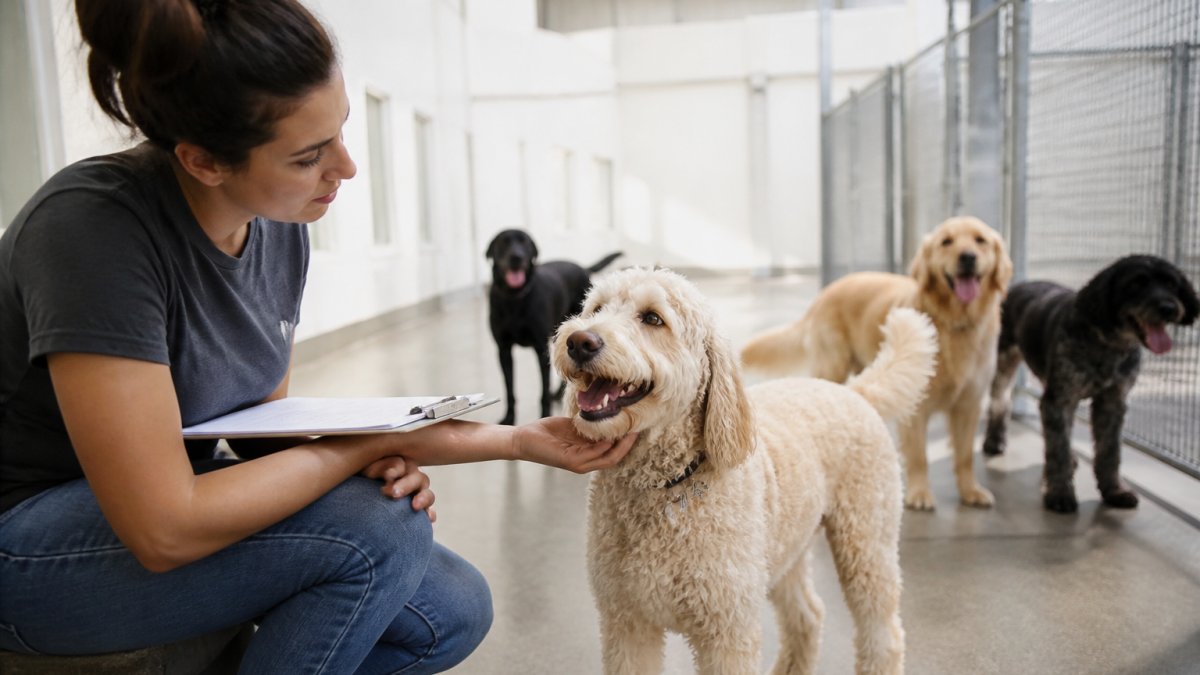
Puppy temperament testing for daycare is how staff judge whether a puppy is ready for group play. They watch how the puppy greets a stranger, reacts to a friendly dog, and handles being handled.
Good staff do not just ask "is this puppy friendly?" They ask "is this puppy ready for this group, today?"
Typical checks we run:
- How the puppy greets a calm adult dog
- Comfort with handling of paws, ears, and collar
- Reaction to sudden sounds and everyday noises
A short evaluation protects your puppy and the group. It also tells you what to work on at home.
Preparing Puppy for First Day of Daycare: A Gradual Acclimation Plan
Preparing puppy for first day of daycare works best as a slow build, not a cold drop-off. Start with short, positive visits and add time as your puppy stays relaxed. For a full walkthrough, see our guide on how to introduce a dog to daycare.
Step-by-Step: The Week Before and the First Visit
- Visit once for a meet-and-greet. No play, just a look around and treats from staff.
- Do a short trial day. A few hours, then pick up before your puppy is worn out.
- Add time gradually. Lengthen each visit over several days.
- Keep drop-offs calm. A quick, cheerful goodbye beats a long, anxious one.
- Ask for updates. A photo or note tells you how the day went.
- Watch the pickup. A relaxed, tired puppy is a good sign. A frantic one means slow down.
Expected result: by the end of the week, your puppy walks in with a wagging tail and looks for staff.
Signs of Puppy Overstimulation and How to Spot Healthy Play
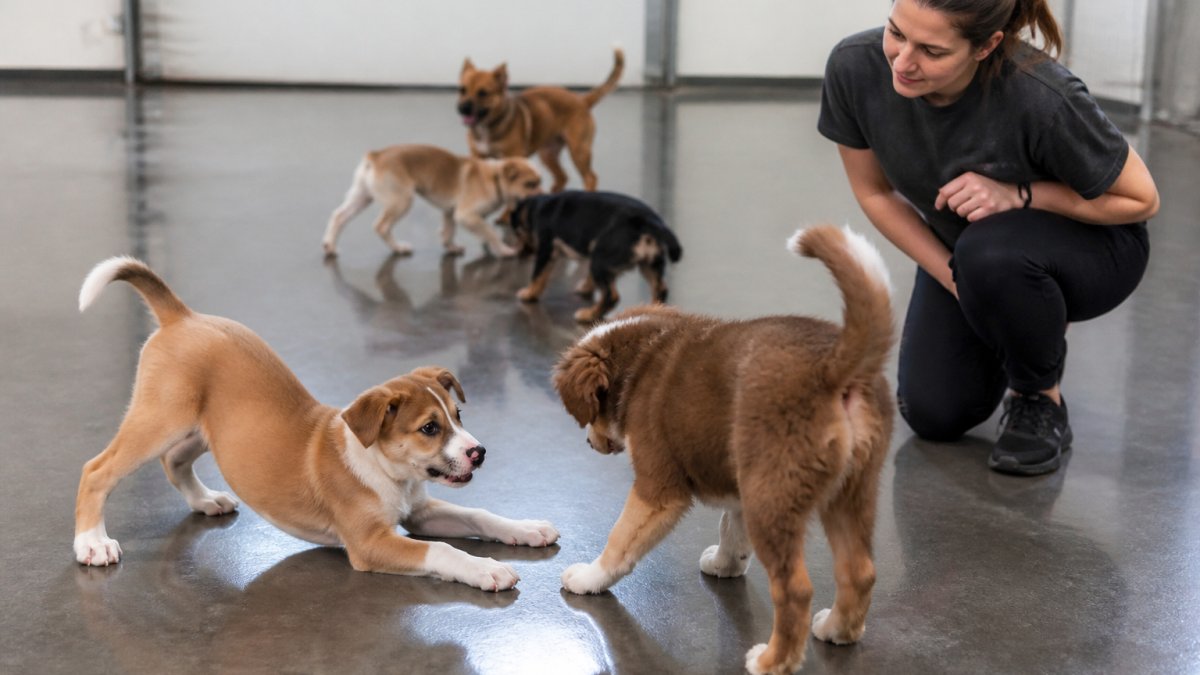
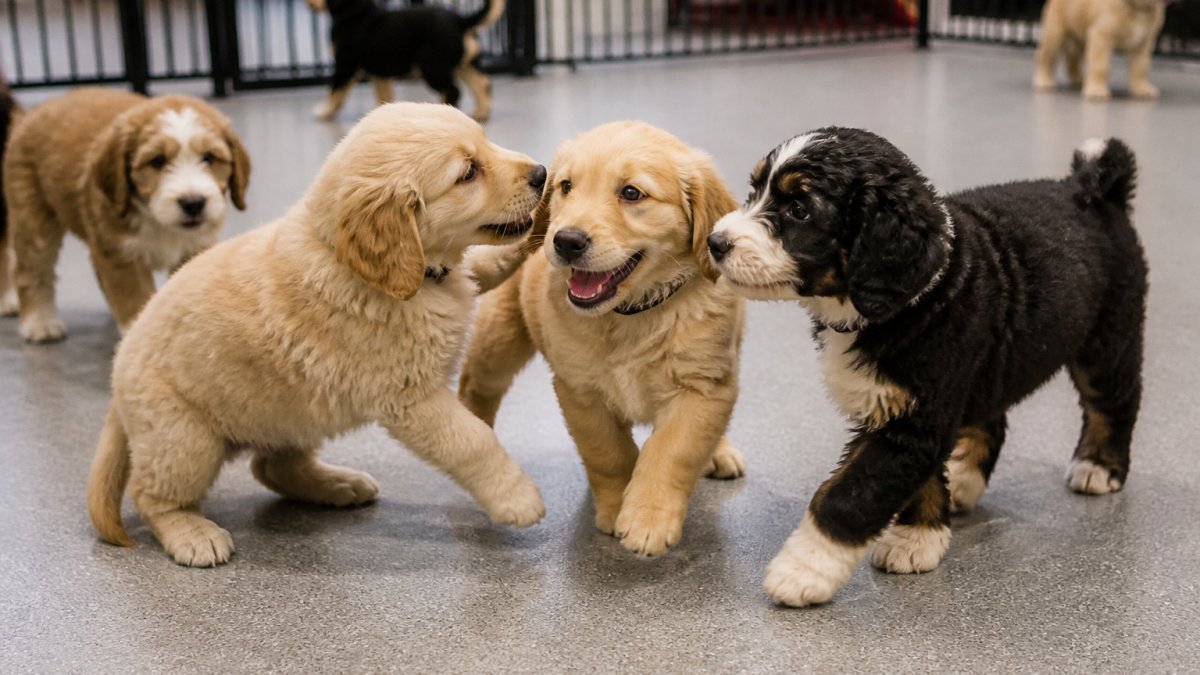
Signs of puppy overstimulation are easier to catch if you read play as a sequence rather than a snapshot. Healthy play cycles through four phases: invitation, engagement, pause, and reset.
The Healthy-Play Sequence
- Invitation: a play bow, a hip nudge, or a paw lift, one puppy asking, the other answering
- Engagement: loose, bouncy movement, turn-taking, role reversal (the chaser becomes the chased)
- Pause: a brief break, shake-off, sniff, drink of water, look away
When you see all four phases repeating, play is healthy. When the pause and reset disappear, you are watching a puppy lose their off-switch.
Body-Language Cues, Ranked by Urgency
Green, keep playing:
- Loose, wiggly body and a wagging tail carried at mid-height
- Play bows and exaggerated, bouncy movements
- Turn-taking and self-handicapping (the bigger dog lies down)
Yellow, pause and watch:
- Stiff body, tail high and fast, or tail tucked
- Lip licking, yawning, or turning the head away
- One puppy pinned or cornered repeatedly
Red, separate now:
- A puppy who cannot settle even when play stops
- Frantic zooming, nonstop barking, or nipping that escalates
- Tucked tail, hiding, or trying to climb out of the play area
The single most useful cue is the pause. A puppy who pauses, shakes off, and re-engages is regulating. A puppy who never pauses is accumulating stress, even if the play looks happy.
When to Pause, Separate, or End the Session
Staff should step in with a rest break before a puppy tips over the edge, not after. A common pattern is a 5-to-10-minute break in a quiet space every 15 to 20 minutes of active play for young puppies, with the frequency increased for excitable or shy dogs.
- Pause: call a break at the first yellow cue, before the puppy loses the ability to settle
- Separate: at any red cue, or when one puppy has been pinned or cornered more than once
- End the session: if the puppy cannot recover after a break, or if the same conflict repeats
Close supervision and quick conflict intervention are what separate good play from chaos. Our guide on the benefits of supervised dog play breaks down what healthy play should look like.
How to Evaluate Daycare Supervision and Group Management
Ask direct questions when you tour a facility. The answers tell you more than the lobby decor.
Check these:
- How many staff watch each group, and are they trained?
- How are groups split by size, age, and play style?
- What is the staff-to-dog ratio during peak hours?
- How do staff handle a scuffle or a scared puppy?
A good facility welcomes the questions. One that dodges them is telling you something. Look for clear orientation for new puppies and a plan for behavior problems before they grow.
Daycare vs. Other Socialization Options: Classes, Playdates, and Home Exposure
Daycare is one option among several. Puppy classes and training classes teach skills with a trainer's eye. Playdates with a known, steady dog are low-risk. Home exposure to sounds, sights, and surfaces builds calm at home before group settings.
For a full side-by-side, read our dog daycare vs local alternatives comparison.
| Option | Best For | Watch Out For |
|---|---|---|
| Daycare | Busy owners, regular social time | Needs good supervision and screening |
| Puppy classes | Structured skills and guidance | Limited free play time |
| Playdates | Shy or cautious puppies | Depends on the other dog's manners |
| Home exposure | Building calm before groups | No dog-to-dog practice |
Many owners combine them: socialization at home first, then puppy daycare a couple of days a week. Twice weekly is a common starting rhythm.
A shy puppy needs extra care. Our step-by-step guide on how to socialize a shy puppy walks through a slower plan.
Book Your Puppy's Daycare Evaluation at Ruffin' It Ranch
Readiness comes down to a calm puppy, current vaccination status, and a facility you trust. Ruffin' It Ranch offers 24/7 on-site professional staff, a climate-controlled environment, and large private indoor and outdoor runs.
Ready to start? Read our guide on booking professional dog daycare, then book your puppy's evaluation and let us build a gentle plan for the first visit.
Frequently Asked Questions
At what age can a puppy start dog daycare?
Most facilities accept puppies once they have completed their core vaccination series, which usually lands around 16 weeks, though some require the final round plus a short waiting period. Puppy daycare requirements vary, so ask about age minimums and vaccine records before booking. Starting too early, before immunity is established, raises disease risk. Starting too late can miss part of the socialization window. A good middle ground is to begin home-based exposure early and schedule a daycare evaluation as soon as your veterinarian clears your puppy.
How do I know if my puppy is ready for daycare socialization?
Look for basic comfort with handling, a willingness to approach unfamiliar people, and the ability to recover quickly from a startle. Your puppy should have age-appropriate vaccines, be free of contagious illness, and handle a few hours away from you without panic. If your puppy shuts down or shows fear, a slower acclimation plan is the better next step.
What are the signs of puppy overstimulation at daycare?
Watch for frantic zoomies that do not stop, mounting, humping, or nipping that escalates instead of easing. A puppy that is overstimulated may pant heavily, pace, whale-eye (show the whites of the eyes), tuck its tail, or avoid other dogs entirely. Healthy play includes play bows, turn-taking, and brief pauses where both dogs shake off and reset. Ask the daycare how they handle rest breaks. Scheduled downtime, often called nap or rest periods, prevents a puppy from spiraling into exhaustion and conflict.
What should I do to prepare my puppy for their first day of daycare?
Visit the facility beforehand so your puppy can sniff the lobby and meet staff without the pressure of a full playgroup. Bring a familiar blanket or toy that carries a home scent, and pack any food or medication with clear instructions. Feed a normal meal a couple of hours before drop-off, and take a long walk to burn off nervous energy. On the day itself, keep goodbyes short and calm. Ask the staff for a mid-day update and plan an early pickup for the first visit so the experience ends on a positive note.
The hardest part of puppy socialization is not the first day. It is keeping the pace slow enough that your puppy stays confident. If you want a team that watches body language closely and adjusts to your puppy's needs, Ruffin' It Ranch is here. Get started with Ruffin' It Ranch and give your puppy a calm, confident first step into group play.