 how-to
7 Specialized Care Tips for Dogs With Medical Needs
Last Updated: October 30, 2026
Quick Summary
Specialized care for dogs with medical needs means a facility follows your vet's written care plan, gives medication on time, logs every dose, watches for changes, and calls your vet when something looks off. It is not veterinary medicine, so confirm who gives meds, how doses are documented, and which emergency hospital is used after hours.
- A real medication log records the drug name, dose, exact time, staff initials, and notes for every dose.
- Insulin is typically given within a narrow window around a meal, often about 12 hours apart.
- Pack more medication than the length of your trip in case you are delayed.
- Ask whether staff are on site overnight or on call, and get the after-hours emergency vet's name in writing.
- Keep a one-page care summary of diagnoses, medications, both vets, and your emergency hospital.
Table of Contents
- What Specialized Care for Dogs With Medical Needs Actually Covers
- Dog Boarding With Medication Administration: What to Confirm Before You Book
- Dog Boarding Medical Forms: The Paperwork That Protects Your Dog
- Questions to Ask a Dog Boarding Facility When Your Dog Has Health Issues
- Preparing a Dog for Boarding When Medication and Routine Matter
- Managing Chronic Conditions at Home Between Stays
- Specialist or General Practitioner? Choosing the Right Vet for Your Dog
- Book a Stay That Matches Your Dog's Medical Needs
- Frequently Asked Questions
What Specialized Care for Dogs With Medical Needs Actually Covers
Specialized care for dogs with medical needs is the extra layer of support a pet requires when standard boarding, feeding, and exercise routines are not enough. For a deeper guide on choosing boarding services for special needs dogs, see our article.
Here is the core tension most owners miss. A good boarding facility is not a veterinary clinic. It should not pretend to be one.
Conditions That Require More Than Standard Boarding
Some dogs need more than a run and a meal. Common examples include:
- Diabetes that requires insulin shots on a fixed schedule
- Seizure disorders needing daily anti-seizure medication
- Arthritis or post-surgery recovery with limited mobility
The American Veterinary Medical Association's guidance on pet health makes a useful point: chronic conditions are managed, not cured, so consistency matters more than intensity. A missed dose does more damage than a slightly boring day.
If your dog is older and needs extra attention, our guide to luxury dog boarding for senior dogs walks through what to look for.
Dog Boarding With Medication Administration: What to Confirm Before You Book
Ask one question first: who gives the medication, and how do they prove it happened? A facility that cannot answer that clearly is not ready for a dog with medical needs.
The Medication Log Is the Whole Ballgame
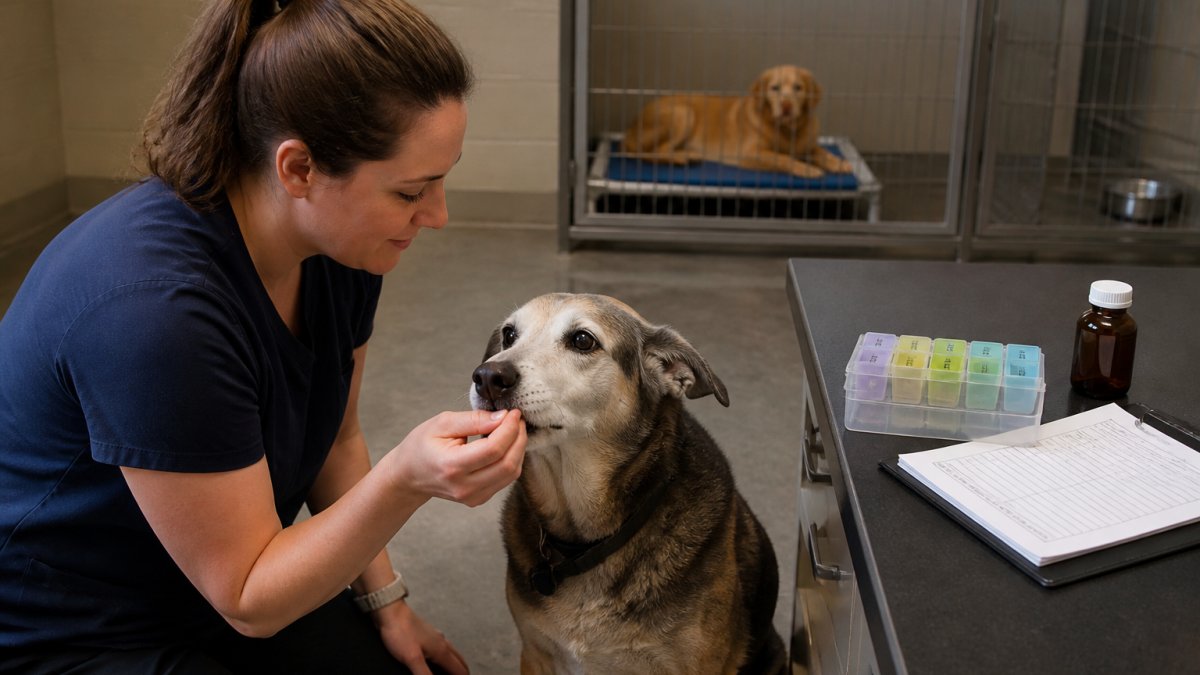
A real medication log is not a sticky note on a kennel door. It should record, for every dose: the medication name, the dose given, the exact time, the staff member's initials, and a notes field for anything unusual (refused food, vomiting, lethargy, a missed or late dose). Ask to see a blank copy before you book, and ask how you will receive it, a photo at pickup, a daily email, or a shared app.
Timing Windows That Actually Matter
"Morning and evening" is not a schedule for every drug. A few patterns are worth understanding before you hand over the leash:
- Insulin is typically given within a narrow window around a meal, often about 12 hours apart. A facility that feeds at 7 a.m. and gives insulin at 9 a.m. is not following most vets' protocols. Confirm the meal-to-injection gap your vet specified.
- Anti-seizure medications such as phenobarbital and potassium bromide are dosed to maintain steady blood levels. A dose that is hours late can lower the seizure threshold. Ask how the facility handles a delayed dose and whether it documents it.
- Pain medications after surgery often run on a fixed interval (for example, every 8 or 12 hours). Confirm the facility will not "wait until the dog seems uncomfortable."
A verbal "sure, we can do that" without a written plan is where most medication mistakes start. Get the schedule in writing, signed by both parties, before drop-off.
Storage, Security, and the 2 A.M. Question
Ask any facility how it stores medications that need refrigeration and how it secures and logs controlled substances. Ask directly: who holds the key, and how is the count reconciled at pickup?
Then ask the question most owners forget: what happens at 2 a.m.? Confirm whether staff are on site overnight or on call, what the response time is, and which emergency veterinary hospital the facility uses after hours.
What to Bring and How to Label It
Pack medications in their original labeled bottles where possible. Bring more than the length of your trip in case you are delayed.
If your dog is older and needs extra attention, our guide to luxury dog boarding for senior dogs walks through what to look for.
Before you hand over the leash, here are the medication timing patterns worth confirming with any facility.
| Medication | Timing pattern | What to confirm |
|---|---|---|
| Insulin | Narrow window around a meal, often about 12 hours apart | The meal-to-injection gap your vet specified |
| Anti-seizure medications | Dosed to maintain steady blood levels | How a delayed dose is handled and documented |
| Pain medications after surgery | Fixed interval, for example every 8 or 12 hours | Staff will not wait until the dog seems uncomfortable |
| Thyroid medication | Commonly given on an empty stomach | Staff can dose separately from feeding |
Dog Boarding Medical Forms: The Paperwork That Protects Your Dog
Paperwork is not bureaucracy here. It is the difference between a staff member guessing and a staff member knowing.
A solid medical form covers medication names, doses, and times, plus your vet's contact info, diagnoses, allergies, feeding instructions, and a signed authorization to seek emergency care. Bring it filled out, not blank.
Records Your Vet Should Send Ahead
Ask your vet to forward:
- Vaccination history
- Current medication list with dosing
- Recent bloodwork if your dog is on long-term meds
The FDA's Center for Veterinary Medicine notes that pet owners should keep clear records of any prescription pet food or medication, which is exactly the kind of detail a boarding facility needs in writing.
Questions to Ask a Dog Boarding Facility When Your Dog Has Health Issues
The right questions separate a facility that can handle medical needs from one that simply says yes. Ask these before booking:
- Can you show me your medication log?
- What is your staff-to-dog ratio overnight?
- How do you handle a dog that stops eating?
That last one matters more than people think. Knowing the signs of stress in boarding dogs helps you judge whether the updates you get actually reflect a calm, well-cared-for animal.
Preparing a Dog for Boarding When Medication and Routine Matter
Preparation starts a week out. Pack medications in their original bottles with clear labels. Bring more than you need in case your trip runs long.
Keep the routine as close to home as possible. Same food, same walk times where you can, same comfort item from home.
Our complete boarding preparation checklist covers the full packing list and drop-off steps.
Managing Chronic Conditions at Home Between Stays
The work between boarding stays matters as much as the stay itself. A few habits keep a dog with medical needs steadier:
- Keep a simple daily log of meds, appetite, and energy
- Store medication where it stays cool and dry
- Refill prescriptions before you run low, not after
This is also where money planning helps. Chronic conditions mean recurring costs, so set aside a monthly amount for meds, checkups, and boarding. Ask your vet about refill schedules so you buy in bulk where it saves money.
Specialist or General Practitioner? Choosing the Right Vet for Your Dog
Most owners never get a clear answer to this question, so here is a framework you can actually use. Your general practitioner is the quarterback; a specialist is the surgeon, cardiologist, or neurologist brought in for a specific problem. The skill is knowing when to escalate, and how to keep both vets talking to each other afterward.
A Simple Escalation Framework
Ask three questions in order:
- Does the diagnosis require equipment or training your GP does not have in-house? Ultrasound, MRI, echocardiography, endoscopy, and radiation therapy are common examples. If the answer is yes, a referral is usually the next step.
- Has the current treatment stopped working, or is the condition worsening despite compliance? A dog whose seizures are increasing on medication, or whose diabetes is hard to regulate, often needs an internal medicine or neurology workup.
- Is the condition one your GP treats rarely? Rarity matters. A GP may see hundreds of ear infections a year and a handful of adrenal tumors. Volume builds judgment.
If two of the three answers point toward referral, ask your GP for one. A good GP will welcome the question; a defensive response is itself information.
Conditions That Commonly Warrant a Specialist
A few patterns show up again and again in referral practice:
- Neurology, seizure disorders that are hard to control, spinal pain, wobbliness, or sudden loss of balance.
- Cardiology, heart murmurs that need an echocardiogram, or a dog that faints.
- Oncology, any new mass, especially one that is growing or changing.
This is not a checklist to self-diagnose against. It is a vocabulary for the conversation with your GP.
How the Two Vets Should Share Records
The handoff is where care often breaks down. Ask your GP to send the specialist a summary, diagnosis, current medications with doses, recent bloodwork, and what has already been tried. Ask the specialist to send a written report back to your GP, not just to you. Then ask your GP to note the specialist's plan in your dog's chart so that anyone, including a boarding facility, reading the record sees one current plan, not two competing ones.
Keep a one-page "care summary" of your own: diagnoses, medications with doses and times, both vets' names and phone numbers, and the emergency hospital you would use. Update it after every visit. It is the single most useful document you can hand a boarding facility.
When a Specialist Is Not the Answer
Specialty care is not free, and it is not always better. For many chronic conditions, well-controlled arthritis, stable thyroid disease, mild allergies, a GP who knows your dog is the right long-term manager. The goal is not to see a specialist; it is to see the right level of care at the right time.
Our complete boarding preparation checklist covers how to package this care summary for drop-off.
Book a Stay That Matches Your Dog's Medical Needs
The real challenge is finding a facility that treats your dog's care plan as instructions, not suggestions. That means trained staff, written medication logs, overnight supervision, and honest communication when something changes.
At Ruffin' It Ranch, we focus on individualized care. If you want a facility that reads the fine print on your dog's health, start with our guide to finding safe dog boarding, then book a stay with Ruffin' It Ranch and travel with real peace of mind.
Frequently Asked Questions
What does specialized care for a dog with medical needs include?
It covers the daily details a standard boarding stay skips: timed medication administration, monitoring for changes in appetite or energy, feeding a prescribed or raw diet, and keeping private space for a dog that should not be grouped with others. Staff should also know your vet's contact information and your authorization to seek emergency treatment. Ask any facility to walk you through exactly how each of these is handled before you book.
Can dogs with medical conditions stay at a boarding facility?
Many can, provided the facility has staff on site around the clock and a clear medication protocol. Dogs with stable, managed conditions such as diabetes, arthritis, or thyroid issues usually do well. Dogs recovering from surgery or in an active health crisis may need a veterinary hospital instead. Ask whether a veterinarian is on site or on call, and confirm who administers medication and how doses are logged.
How should I prepare my dog's medications for boarding?
Pack each dose in a labeled pill organizer or individual bag marked with your dog's name, the drug, the dose, and the time. Bring more than the exact number of days you are away in case your trip runs long. Include written instructions even if you have already explained them verbally, and hand the medication directly to a staff member rather than leaving it in a bag. Confirm the facility's policy on storing refrigerated medications if your dog needs them.
Is a veterinary hospital or a boarding facility better for a dog that needs medication?
It depends on how stable your dog is. A veterinary hospital suits dogs recovering from surgery, needing daily monitoring of bloodwork, or in an active crisis. A boarding facility with 24/7 staff fits dogs whose condition is managed and whose main need is reliable medication timing, a consistent diet, and low-stress surroundings. If your dog's needs change before the stay, call the facility and your vet to decide together rather than canceling on assumption.