 how-to
How Can You Help a Dog Adjust to a New Home?
Last Updated: October 29, 2026
Quick Summary
To help a dog adjust to a new home, treat the first month as small stages instead of one big event, opening one room at a time and keeping routines predictable. The 7-7-7 rule maps the first three weeks: three days of decompression, seven days of settling, and seven days of trust building. Progress when you see readiness signals, not when the calendar says so.
- Open one room, then two, then the whole house over a week or two.
- Feed, walk, and put your dog to bed at the same times every day.
- Stress hormones can stay elevated for 48 to 72 hours after a big change.
- A puppy should sleep in a crate or cozy bed in your bedroom the first night.
- Call your vet if a dog won't eat for more than 24 hours or won't drink.
Table of Contents
- Start With a Staged Plan, Not a Sprint
- How Long Does It Take a Dog to Adjust to a New Home?
- The 7-7-7 Rule for Dogs, Explained
- New Dog First Week Tips: Routine, Safe Space, and Belongings
- Where Should a Puppy Sleep First Night in a New Home?
- Moving-Day Logistics and a Home-Safety Checklist
- Spotting Stress and Knowing When to Get Help
- Book a Calm First Stay at Ruffin' It Ranch
- Frequently Asked Questions
Start With a Staged Plan, Not a Sprint
Here's the core idea: treat the first month as a series of small stages, not one big event.
A common mistake is giving a dog full run of the house on day one. That feels generous. It's actually overwhelming.
The American Veterinary Medical Association's pet behavior resources notes that sudden environment changes rank among the most common triggers for stress-related behavior in dogs.
Below, we'll walk through realistic timelines, the 7-7-7 rule, first-week routines, and a safety checklist you can use on moving day itself.
How Long Does It Take a Dog to Adjust to a New Home?
The time a dog needs to settle into a new home varies widely, depending on age, temperament, and past experience.
Puppies often bounce back in days. A senior dog or a rescue with a rough history may need months of patience.
Many owners find the first 72 hours are the hardest. Whining, pacing, and a lost appetite are common.
So how do you speed it up? Consistency does more than any single trick:
- Feed at the same times every day
- Walk the same route at first
- Keep the same bedtime
- Use the same words for commands
The adjustment period isn't a test your dog passes or fails.
The 7-7-7 Rule for Dogs, Explained
The 7-7-7 rule is a simple framework for the first three weeks after a big change: three days of decompression, seven days of settling, and seven more of building trust. It gives owners a realistic map instead of a vague "give it time."
Here's how each stage usually looks, with the concrete signals that tell you your dog is ready to move forward:
| Stage | Days | What to Expect | What to Do | Signs Your Dog Is Ready to Progress |
|---|---|---|---|---|
| Decompression | 1-3 | Shutdown, hiding, poor appetite, reluctance to walk through doorways | Keep things quiet, limit visitors, hand-feed if appetite is low, keep the leash on indoors for the first 24 hours | Eats most of a meal, comes out of hiding when the house is quiet, accepts a treat from your hand |
| Settling | 4-10 | Curious but cautious, testing routines, occasional accidents, waking at odd hours | Start a steady schedule, short walks on the same route, begin name recognition and a single cue like "sit" | Sleeps through most of the night, seeks out the safe space on its own, follows you room to room |
| Trust building | 11-21 | Personality returns, bonds form, play behavior emerges | Add gentle training, introduce one new room or experience at a time, begin short positive-reinforcement sessions | Initiates play, greets you at the door, relaxes on its side with belly exposed |
The first three days matter most. A dog in decompression mode isn't being difficult. Their nervous system is simply overloaded, and the stress hormone cortisol can stay elevated for 48 to 72 hours after a big change. That's why the standard advice is to do less, not more, in the first 72 hours.
What most guides miss is that the 7-7-7 rule is a guide, not a deadline. Some dogs move faster. Others need double the time. Watch your dog, not the calendar. A useful rule of thumb: progress to the next stage when you see two or three of the readiness signals in the table, not when the calendar says so.
If your dog stalls in one stage, say, still hiding on day 10, don't push forward. Drop back to the previous stage's routine for a few days.
New Dog First Week Tips: Routine, Safe Space, and Belongings
The best first-week tips come down to three things: a steady routine, a safe space, and familiar belongings. Get those right and the rest gets easier.
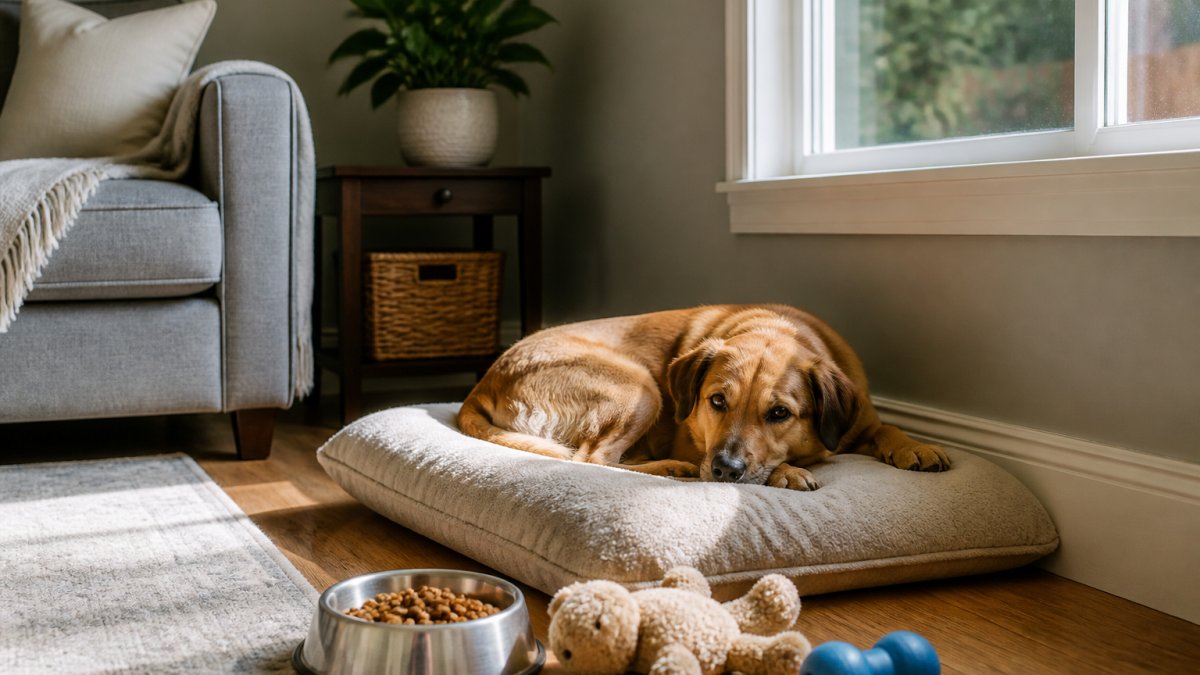
Set the routine first. Pick feeding times, walking times, and a bedtime, then stick to them daily.
Build a safe space. A quiet room or a crate with the door open works well.
Bring the old smells. Familiar toys, blankets, and even an unwashed item from your old home carry reassurance.
If your dog will spend time in a crate, especially one with separation anxiety, our guide on how to crate train a dog with separation anxiety walks through the setup step by step.
Keep visitors away for the first few days. Crowded rooms undo progress fast.
Where Should a Puppy Sleep First Night in a New Home?
A puppy should sleep in a crate or cozy bed in your bedroom on the first night in a new home.
The first night is rarely perfect. Expect some whining.
A few practical tips:
- Put the crate beside your bed
- Use familiar bedding from the breeder or shelter
- Keep the room dark and quiet
- Take the puppy out for a potty break before bed and once overnight
Avoid bringing the puppy into your bed if you don't want that long term. Changing the rules later confuses them.
Toilet training and house training go hand in hand with sleep.
Moving-Day Logistics and a Home-Safety Checklist
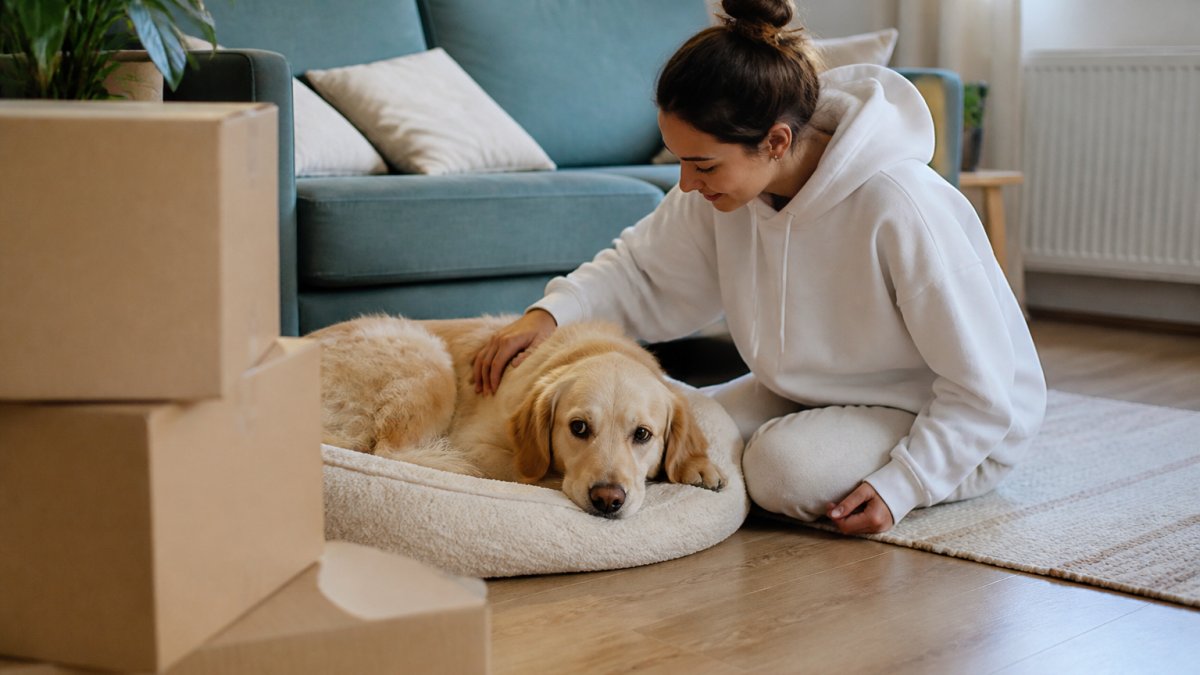
Moving day itself is where things go wrong. The door stays open, boxes pile up, and strangers walk in and out.
Start with a plan for where your dog will be during the busiest hours.
Then run this checklist before your dog explores the new home:
- Secure loose cords and cables
- Block off stairways with a baby gate
- Check for gaps in fences and gates
- Store cleaning products and chemicals out of reach
- Remove toxic plants
- Set up the crate and safe space before arrival
Watch out: a dog who bolts through an open door on moving day can be gone in seconds.
Supervision matters for the first few days of exploration.
Spotting Stress and Knowing When to Get Help
Stress in a newly moved dog shows up in behavior changes, not just obvious panic.
Tier 1, Normal adjustment stress (expected in the first 1-2 weeks):
- Pacing or restlessness in the evening
- Hiding under furniture but coming out for food
- Mild appetite drop, eating most meals but leaving some
- One or two indoor accidents in a previously house-trained dog
- Alert barking at new sounds like the furnace or elevator
These signs usually fade as routine takes hold.
Tier 2, Stress that needs a routine change (adjust within 48 hours):
- Refusing meals for more than 24 hours
- Excessive panting or drooling at rest, with no heat or exercise trigger
- Destructive chewing focused on doors, window frames, or exit points
- Barking or whining when left alone that continues past 20-30 minutes
- Freezing or pancaking when you approach, or refusing to walk through a doorway
Tier 3, Call your veterinarian or a qualified behavior professional:
- Any sign of self-injury, chewing paws raw, licking a hotspot, breaking teeth on a crate
- Not eating for more than 48 hours, or vomiting and diarrhea that persist past a day
- Panic at being left alone: howling, drooling, destructive escape attempts, or injury at exits
- Sudden aggression, growling, snapping, or resource guarding that appears after the move
- Stress signs that are still present after 3-4 weeks with a consistent routine
What a professional will actually do: your veterinarian can rule out medical causes (pain, dental disease, thyroid issues) that mimic anxiety, and can discuss short-term anti-anxiety medication for dogs in acute distress during a transition. A qualified behavior professional, look for a board-certified veterinary behaviorist (DACVB) or a certified applied animal behaviorist (CAAB) for severe cases, or a CPDT-KA or KPA-CTP trainer for milder ones, will build a behavior modification plan rather than just management. The American Veterinary Medical Association's pet behavior resources is a reasonable starting point for finding credentialed help.
A skittish dog who seems overwhelmed may just need a slower pace.
For rescue dogs still learning to feel safe, safe socialization for rescue dogs offers a step-by-step plan that pairs well with settling into a new home. And if the stress is concentrated around being left alone, our deeper guide on how to help a dog with separation anxiety covers the training protocol in detail.
Book a Calm First Stay at Ruffin' It Ranch
Sometimes the kindest thing during a move is a calm, supervised place for your dog to wait it out. That's where we come in.
At Ruffin' It Ranch, our climate-controlled facility has private indoor and outdoor runs, and our team is on-site 24/7. If your dog needs a quiet stay while the boxes clear, cage-free boarding in Marlboro, NJ gives you the details.
Before the first visit, a little prep goes a long way. Our complete boarding preparation checklist helps you pack the right belongings and set your dog up for a relaxed stay.
We also offer flexible play care and monthly daycare packages, so a move doesn't have to mean weeks of stress for your dog.
Frequently Asked Questions
How long does it take a dog to adjust to a new home?
The time a dog needs to adjust varies. The 7-7-7 rule is a useful guide for planning the first few weeks. Puppies, rescues, and anxious dogs often take longer. Watch for steady improvement in eating, sleeping, and willingness to explore. If your dog is still hiding or refusing meals after several weeks, talk to your veterinarian about next steps.
Should I leave my new dog alone during the first few days?
Keep alone time short at first. Stay nearby for the first few days, then practice brief absences of 10 to 15 minutes and build up gradually. Leave familiar bedding and a toy, and keep departures calm. A dog that panics when left alone may need a slower plan, or a professional daycare setting with supervised play while you are at work.
What is the 7-7-7 rule for puppies?
The 7-7-7 rule breaks adjustment into three phases: decompression, settling in, and building trust and routine. During the first week, keep things quiet and predictable. In the second, introduce short walks and gentle greetings. Over the following weeks, expand training, visitors, and new places at your puppy's pace.
What should I do if my dog is anxious after moving?
Go back to basics: consistent feeding and walking times, a quiet room with familiar bedding, and calm, low-key interactions. Skip crowded rooms and new people for a few days. If anxiety is severe, such as constant pacing, drooling, or destructive behavior, contact your veterinarian. Professional boarding or daycare with trained staff can also give an anxious dog a safe, supervised routine while you handle moving tasks.
A move is confusing for a dog, and the first week rarely goes perfectly. The good news is that steady routine, a familiar safe space, and patient supervision do most of the work. When you need a hand, Ruffin' It Ranch offers 24/7 on-site staff, private indoor and outdoor runs, and individualized care for every dog, including puppies and those with special needs. Get started with Ruffin' It Ranch and give your dog a calm, safe place to land.