 how-to
How to Add Probiotics to a Raw-Fed Dog's Diet
Last Updated: October 29, 2026
Quick Summary
Raw dog probiotics can help a raw-fed dog through digestive upset, but a complete raw diet does not reliably supply them. Use a labeled canine probiotic with a known strain and dose, and switch to raw food gradually. Involve your veterinarian, especially if symptoms persist.
- Switching from kibble to full raw food too quickly is the most common cause of loose stools.
- Use a gradual transition over about 10 days, moving from 10-25% raw to full raw.
- Choose products with named strains and CFU guaranteed through expiry, not just at manufacture.
- Run a 7-14 day probiotic trial after recording a stool baseline, and stop if no improvement.
- Call your vet if diarrhea lasts over 24-48 hours in adults, or if blood or vomiting appears.
Table of Contents
- Why Raw-Fed Dogs Sometimes Need Probiotic Support
- Natural Probiotics for Dogs: Foods and Supplements Compared
- Probiotic Foods Safe for Dogs and the Raw-Diet Safety Risks to Know
- Switching Your Dog to Raw Food Without Digestive Upset
- How to Choose a Probiotic by Strain, CFU Count and Form
- Dog Probiotics for Diarrhea: When to Use Them and When to Call the Vet
- Booking Your Dog's Raw-Fed Care at Ruffin' It Ranch
- Frequently Asked Questions
Digestive trouble is one of the most common reasons owners move a dog onto raw food, and one of the most common reasons they start asking about raw dog probiotics.
Probiotics are not a universal fix, and a complete raw diet is not automatically a complete gut-support program. Treat a supplement as one tool among several, and bring your veterinarian into the decision, especially if your dog has ongoing digestive symptoms.
Why Raw-Fed Dogs Sometimes Need Probiotic Support
Raw feeding changes the food, the bacteria the dog is exposed to, and the speed of change, each of which can affect the gut. Many owners notice loose stools in the first few weeks, especially after a quick switch from kibble.
What probiotics and prebiotics do in a dog's gut
Probiotics are live microorganisms that, given in adequate amounts, can confer a health benefit on the host. In dogs, the strains most often studied for digestive support belong to the Lactobacillus and Bifidobacterium groups. Prebiotics are fibers and compounds that feed beneficial bacteria already living in the intestine.
Probiotics are generally described as supporting gut microbiome balance, stool consistency, and general digestive function. Evidence strength varies by strain and condition, so the label alone tells you little about whether a specific product will help.
Does a complete raw diet already supply probiotics?
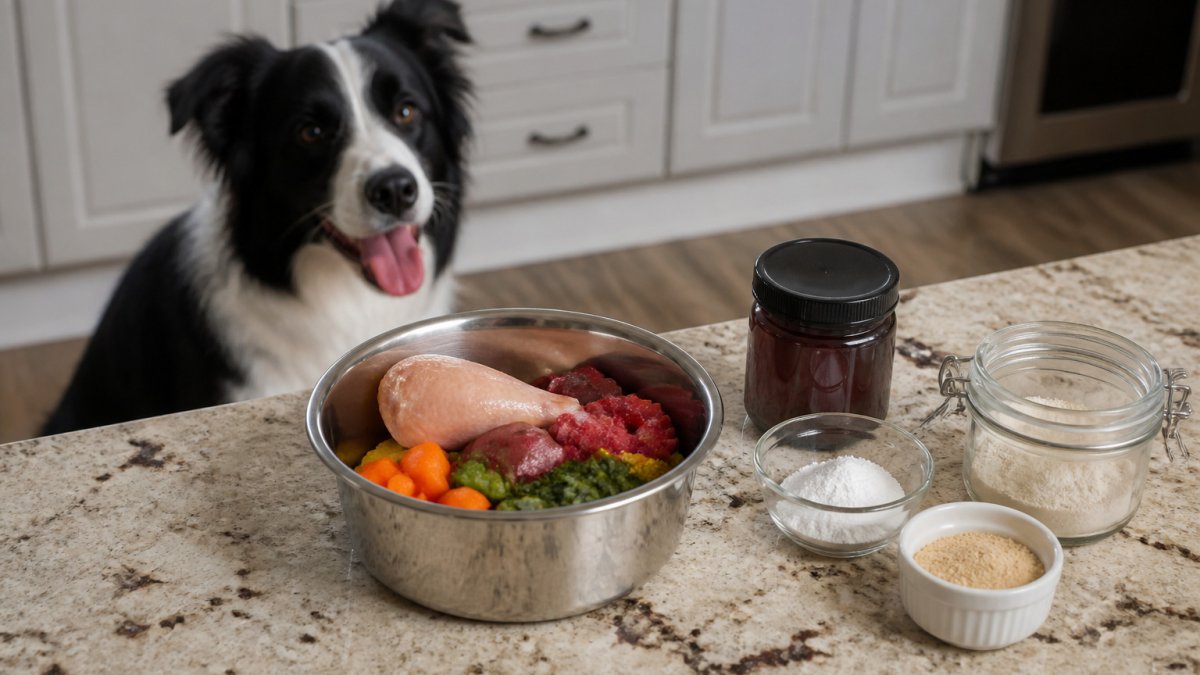
Not reliably. See whether raw food is inherently beneficial for dogs overall in this same-topic guide. Raw meat and bones contain microorganisms, but the types and numbers vary batch to batch and are not designed to act as a dosed probiotic. A complete and balanced raw diet supports nutrition; it is not a guaranteed source of therapeutic bacteria.
Natural Probiotics for Dogs: Foods and Supplements Compared
Owners usually have two routes: whole foods that naturally contain live cultures, and manufactured supplements with a known strain and dose. The table below summarizes the trade-offs.
| Option | Typical Form | Advantage | Limitation |
|---|---|---|---|
| Plain plain yogurt (unsweetened) | Food topper | Easy to find, mild | Culture types and amounts vary; some dogs are lactose-sensitive |
| Kefir | Liquid food topper | Broader mix of cultures | Variable content; not dosed |
| Commercial dog probiotic | Powder, chew, or liquid | Labeled strain and CFU count | Quality and claims vary between brands |
| Prebiotic fiber supplement | Powder | Feeds existing gut bacteria | Can cause gas or loose stool if overdone |
For a predictable dose, a labeled canine probiotic is easier to manage than improvised food toppers. Treat raw dog probiotics from a labeled product as the core plan, and use foods as occasional additions rather than a substitute.
Probiotic Foods Safe for Dogs and the Raw-Diet Safety Risks to Know
Some fermented foods are generally acceptable for dogs in small amounts, such as plain, unsweetened yogurt or kefir. Avoid anything containing xylitol, added sugar, garlic, onion, or heavy seasoning.
Adding probiotic foods to a raw diet does not remove the main raw-feeding risk: pathogens such as Salmonella and Listeria can be present in raw meat and can spread to people in the household.
Switching Your Dog to Raw Food Without Digestive Upset
The most common cause of digestive upset during a raw switch is moving too fast. A gradual transition gives the gut time to adjust.
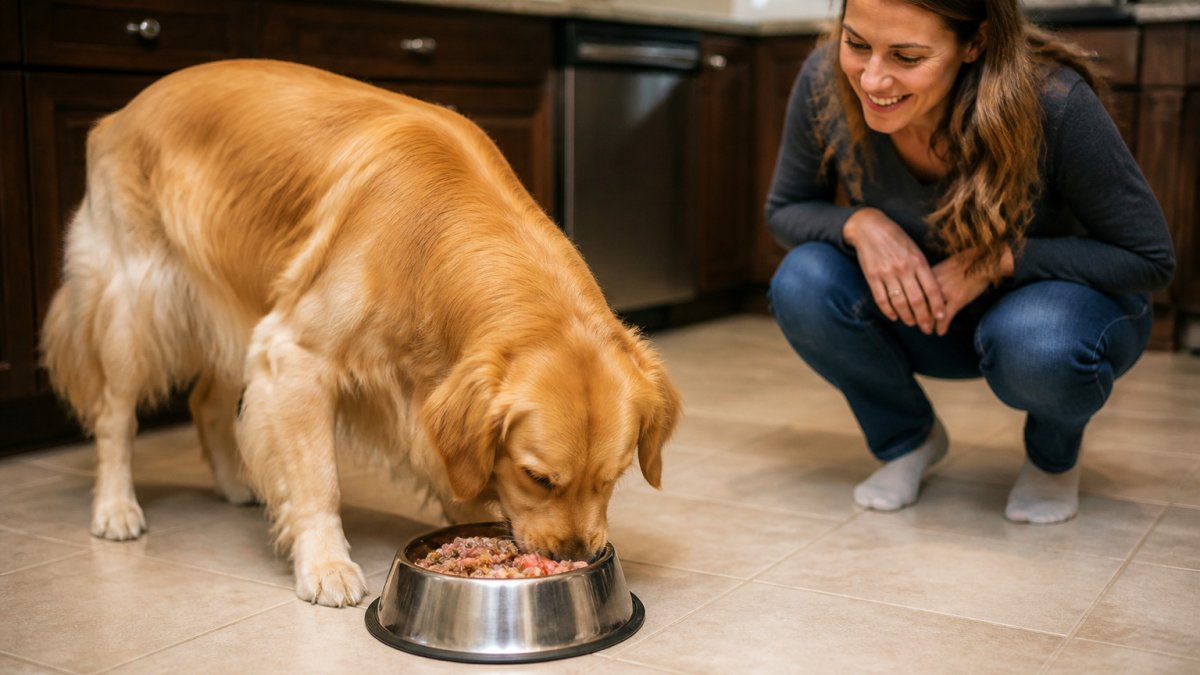
- Days 1-3: Replace about 10-25% of the regular meal with raw food.
- Days 4-7: Increase to roughly 50% raw if stools stay firm.
- Days 8-10: Move to 75% raw.
- Day 11 onward: Feed the full raw diet if stools remain consistent.
Slow the schedule if you see soft stool, gas, or reduced appetite, and hold at the last comfortable step for several days.
Stepping straight from kibble to full raw food is the single most common reason a healthy dog ends up with a week of loose stools. Learn how to calm a stressed dog, since stress can also contribute to digestive upset.
How to Choose a Probiotic by Strain, CFU Count and Form
Most probiotic roundups tell you to "look for a quality brand." That is not useful when two products on the same shelf carry the same species name and very different labels. Read the label the way a veterinarian or nutritionist would: strain first, then viable count, then form and storage, then evidence.
Start with strain identification, not species
A species name such as Lactobacillus acidophilus describes a group, not a specific organism. A strain designation, the letter-and-number code following the species, such as Lactobacillus acidophilus LA-1, identifies a single characterized isolate.
A useful label lists each strain by full designation and shows the CFU count for that strain, not just a blend total.
Read the CFU count at expiry, not at manufacture
CFU stands for colony-forming units, the count of live organisms capable of reproducing. Two numbers matter:
- CFU at time of manufacture is the count when the product was made. It is almost always higher than what is in the container when you open it.
- CFU at expiry (sometimes labeled "guaranteed through expiration") is the count the manufacturer promises on the last day of shelf life. This is the number to compare across products.
A product labeled "10 billion CFU" with no qualifier may be guaranteeing that count at manufacture, meaning the live count at expiry could be substantially lower. "10 billion CFU guaranteed through expiry" is a stronger claim. Neither number tells you the product will work, dose-response varies by strain and dog, but the expiry guarantee is the honest basis for comparison.
Higher is not automatically better. Some studied strains are effective at lower counts, and very high counts can cause loose stool or gas in a sensitive dog. Match the count to the product's labeled dose and your veterinarian's guidance rather than assuming more is stronger.
Check form, storage, and handling
- Powder is easy to mix into raw food and easy to split across meals, but it exposes the culture to air every time you open the container.
- Chews are convenient and palatable, but the manufacturing process can reduce live counts, so the expiry guarantee matters more.
- Liquids are convenient for small dogs and easy to dose by dropper, but many require refrigeration and have shorter shelf life once opened.
Storage instructions are part of the product, not an afterthought. Some probiotics are shelf-stable when kept dry and cool; others require refrigeration to maintain the labeled count. A product that sits in a warm car or humid cabinet may not deliver the CFU count on the label. Follow the manufacturer's storage instructions and check the expiration date before buying.
Weigh the evidence quality
Label claims are not the same as evidence. A product may cite studies on a strain it contains, but the study may have been conducted in a different species, at a different dose, or for a different condition. Look for:
- A named strain that matches published research on digestive support in dogs.
- A dose on the label that is in the same range as the studied dose.
- A manufacturer willing to share strain identity and viability data.
If a product makes sweeping claims ("cures diarrhea," "boosts immunity") without strain-level detail, treat it as a general supplement rather than a therapeutic one. For a raw-fed dog, the goal is predictable support during transitions and mild upset, not a cure for a medical condition.
A quick label checklist
- Full strain designation for each organism, not just genus and species.
- CFU count guaranteed through expiry, not only at manufacture.
- Storage instructions you can actually follow in your home.
- A dose range that matches your dog's size and health status.
- Evidence cited at the strain level, not just "clinically proven."
If a product passes all five, it is a reasonable candidate to discuss with your veterinarian. If it fails two or more, keep looking.
Dog Probiotics for Diarrhea: When to Use Them and When to Call the Vet
A probiotic is a reasonable tool for mild, short-lived loose stools, especially during a diet change, but it is not a treatment for serious illness or a substitute for veterinary care. The useful question is not "should I give a probiotic?" but "what am I watching for, and when do I stop waiting?"
Set a baseline before you start
Before the first dose, record four things for two or three days:
- Stool consistency on a simple 1-7 scale (1 = hard and dry, 4 = log-shaped and firm, 7 = liquid).
- Stool frequency per day.
- Gas and appetite on a simple better/same/worse note.
This baseline is what makes the probiotic trial interpretable. Without it, owners tend to credit the supplement for a change that would have happened anyway, or blame it for a problem that started before the first dose.
A realistic timeline
Most practitioners find that mild diet-change loose stools begin to firm up within a few days of slowing the transition, with or without a probiotic. A reasonable probiotic trial runs 7-14 days at the label dose or the dose your veterinarian recommends. During that window:
- Days 1-3: Expect little visible change. Watch for adverse reactions, increased gas, softer stool, vomiting, or refusal to eat.
- Days 4-7: Look for gradual improvement in consistency and frequency. Improvement is usually gradual, not sudden.
- Days 8-14: If stools are not improving, or are worse, stop the trial and reassess with your veterinarian rather than increasing the dose.
If the stool normalizes, continue at the same dose for a short period and then taper, or follow your veterinarian's plan. If the problem returns when you stop, that is information, it may point to a dietary issue rather than a probiotic deficiency.
When to call the vet instead of waiting
Call your veterinarian promptly, same day if possible, if any of the following apply: compare calming supplements for dogs if stress or anxiety seems to be part of the picture.
- Diarrhea lasts more than 24-48 hours in an adult dog, or more than 12-24 hours in a puppy.
- You see blood (red or black/tarry) or large amounts of mucus.
- Diarrhea comes with vomiting, lethargy, fever, dehydration, or refusal to eat.
Puppies and small dogs dehydrate quickly, and a probiotic is never the right first step for a dog that seems unwell. Never use a probiotic to delay care.
Dosing by size and health status
Dosing should follow the product label or your veterinarian's instructions, adjusted for body weight and health status rather than guessed. A small dog and a large dog rarely need the same amount, and a dog with a chronic condition may need a different strain or approach entirely. If the label gives a weight range, start at the low end and hold there for the trial period.
What "helping" looks like, and what it doesn't
A probiotic is helping if stool consistency improves by at least one point on your scale, frequency decreases, gas settles, and appetite stays normal, without new signs. It is not helping if stools are unchanged or worse after 7-14 days, if new signs appear, or if improvement only lasts while the product is given and reverses when it stops.
Booking Your Dog's Raw-Fed Care at Ruffin' It Ranch
Some owners want help with raw feeding, digestion, or daily care while they are away. Book a stay for your raw-fed dog.
For a complete approach, pair a gradual diet switch with clear stool tracking, a vet-approved probiotic if needed, and a check-in whenever symptoms persist. Digestive problems in a dog are usually manageable, but they deserve attention rather than guesswork.
Frequently Asked Questions
Do dogs on a raw diet need probiotics?
Not every raw-fed dog needs a probiotic. If your dog has ongoing digestive signs, ask your veterinarian before adding a supplement.
What probiotic foods are safe for dogs?
Ask your veterinarian before offering your dog probiotic foods.
How do I choose a probiotic supplement for my dog?
Ask your veterinarian which product and dose fit your dog's health history.
Should I give my dog probiotics when switching to raw food?
Ask your veterinarian whether a probiotic or a diet change is appropriate for your dog.