 blog
Dog Daycare vs Pet Sitting: How to Choose in 2026
Table of Contents
- Dog Daycare vs Pet Sitting: What's the Real Difference?
- How Dog Daycare and Pet Sitting Work
- Dog Daycare Pros and Cons: Socialization, Structure, and Stress
- In-Home Pet Sitting Pros and Cons: Comfort, Routine, and Cost
- A Decision Framework Based on Your Dog's Needs
- Questions to Ask a Dog Daycare Before You Book
- Questions to Ask a Pet Sitter Before You Book
- Costs, Ratios, and Quality Signals That Separate Good Providers
- Frequently Asked Questions
Last Updated: October 18, 2026
Dog Daycare vs Pet Sitting: What's the Real Difference?
Choosing between dog daycare and pet sitting services comes down to one question: does your dog need supervision for part of a day, or full care while you're away?
At Ruffin' It Ranch, we understand the complexities of choosing the right care for your pet.
The two services solve different problems. A high-energy young dog with no outlet during your workday needs structured play.
How Dog Daycare and Pet Sitting Work
Dog daycare and pet sitting work differently in almost every practical way. Daycare moves your dog to a facility for supervised play and rest, then sends him home the same day.

Inside a Daycare Day
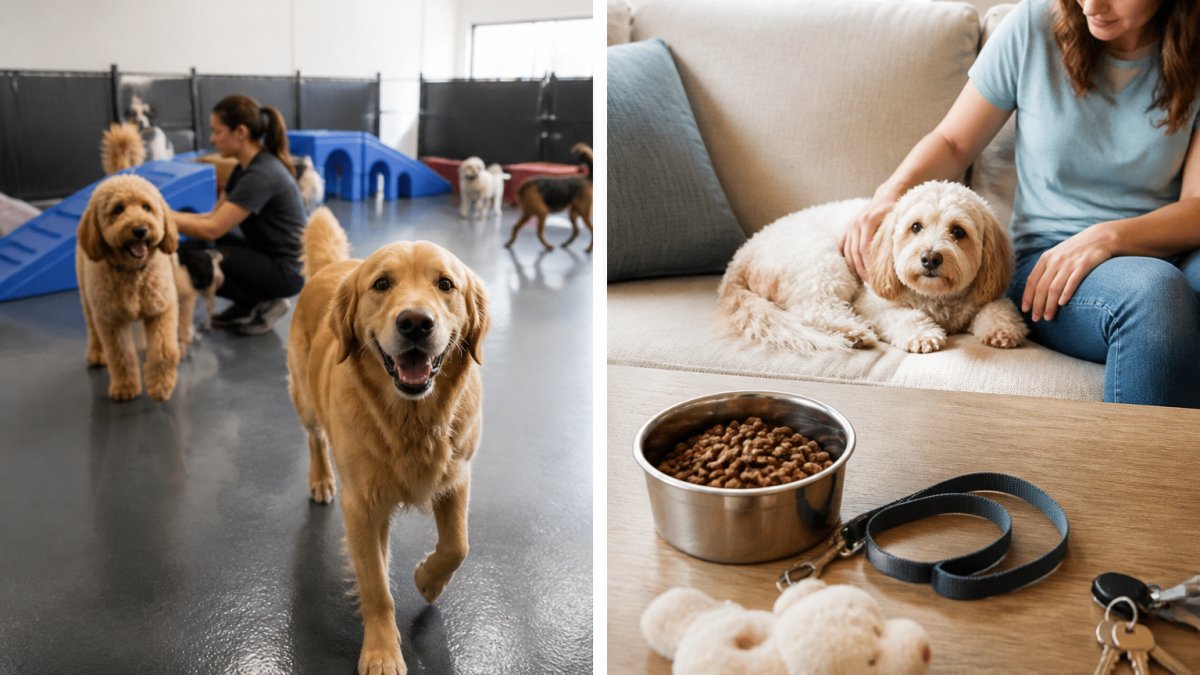
A typical daycare day follows a routine: drop-off, a settling period, alternating blocks of play and rest, meals if scheduled, and pickup. Good facilities separate dogs by size, energy level, and temperament. Private runs exist for dogs who don't do well in group care. Professional supervision runs all day, and staff watch for stress signals, not just scuffles.
What a Pet Sitter Actually Does
A pet sitter covers the home side of care. Drop-in visits handle feeding schedules, medication, litter or yard cleanup, and playtime. Overnight sitting means someone stays in your home. In-home care keeps the dog's routine and familiar environment intact, which matters enormously for anxious dogs, but it means less structured socialization.
Dog Daycare Pros and Cons: Socialization, Structure, and Stress
Dog daycare pros and cons usually center on socialization versus stress. The benefits are real: structured exercise, playtime with other dogs, and professional supervision during your workday. The drawbacks are equally real: group settings stress some dogs, and contagious illness spreads where dogs mix.
The pros:
- Reliable exercise and enrichment on a schedule
- Socialization with other dogs and people
- Professional supervision from trained staff
- A daily routine that suits busy professionals
The cons:
- Group care overwhelms shy or reactive dogs
- Higher exposure to contagious illness like kennel cough
- Less one-on-one attention in large play groups
- Not ideal for dogs who guard toys or food
In-Home Pet Sitting Pros and Cons: Comfort, Routine, and Cost
In-home pet sitting pros and cons come down to comfort versus structure. The clear win is a familiar environment: your dog stays in his own space, keeps his feeding schedule, and avoids the stress of a strange facility. The trade-off is less structured exercise and socialization, plus the cost of multiple visits or overnight stays.
What in-home care does well:
- Preserves routine, home comfort, and feeding schedules
- Ideal for seniors, puppies, and dogs with separation anxiety
- Handles medication and special needs in familiar surroundings
- No exposure to group illness or facility stress
Where it falls short:
- Limited socialization and group playtime
- Drop-in visits leave long gaps between check-ins
- Quality depends heavily on the individual sitter
- Overnight care costs add up fast for multi-day trips
A Decision Framework Based on Your Dog's Needs
A decision framework based on your dog's needs beats any generic recommendation. Instead of asking "which service is better," score your dog on five factors, then let the scores point to the right service. This is the step most owners skip, and it's the one that prevents a stressful booking.
Step 1: Score Your Dog on Five Factors
Rate each factor from 1 (low) to 5 (high). Be honest, not optimistic.
| Factor | What a Low Score (1-2) Looks Like | What a High Score (4-5) Looks Like |
|---|---|---|
| Sociability with other dogs | Avoids dogs, growls, hides, or guards toys | Seeks out play, reads cues well, shares space |
| Energy and exercise need | Content with a short walk and a nap | Needs 60+ minutes of active play to settle |
| Health and vaccination status | Senior, recovering, or unvaccinated | Healthy, current on vaccines, no chronic issues |
| Anxiety and stress tolerance | Panics in new places, destructive when alone | Settles quickly, tolerates new environments |
| Time alone tolerance | Cannot be alone more than 2-3 hours | Comfortable alone for a full workday |
Step 2: Read the Score Pattern
- High sociability + high energy + low anxiety: Dog daycare is the strongest fit. Group play burns energy and provides enrichment.
- Low sociability or high anxiety: In-home pet sitting or private-run daycare. Group settings will likely backfire.
- High time-alone tolerance + low energy: Drop-in pet sitting may be enough for daytime coverage.
- Low time-alone tolerance + multi-day travel: Overnight sitting or boarding, not daycare. Daycare is daytime care only.
Step 3: Match the Service to the Duration
The distinction owners miss most: daycare is daytime care, not overnight care. If you're traveling, daycare alone won't cover it. You need boarding or overnight sitting, which is a separate booking. Map your need to the service before you compare providers:
| Your Need | Service That Covers It |
|---|---|
| Supervision during a workday | Dog daycare or mid-day drop-in visits |
| A few hours out in the evening | Drop-in pet sitting |
| Overnight or multi-day travel | Overnight sitting or boarding |
| Medication and feeding during the day | Drop-in pet sitting or daycare with a care plan |
| Structured exercise and socialization | Dog daycare |
Step 4: Pressure-Test the Choice
Before booking, ask yourself three questions. If any answer is "no," reconsider the service or the provider.
- Can the provider follow my dog's feeding and medication schedule in writing?
- Does the provider have a clear plan for illness, injury, or severe weather?
- Will my dog get a trial session before a full booking?
Questions to Ask a Dog Daycare Before You Book
Questions to ask a dog daycare should cover supervision, screening, and health protocols before you hand over the leash. Ask them on a tour, not over the phone. The answers tell you more than any brochure.
- What is your caregiver-to-dog ratio, and does it change at peak hours?
- How do you screen dogs for temperament before admitting them?
- What vaccination requirements do you enforce?
- How do you separate dogs by size and play style?
Questions to Ask a Pet Sitter Before You Book
Questions to ask a pet sitter should probe experience, backup plans, and communication. A sitter is alone with your dog and your home, so screening matters as much as it does at a facility.
- How many dogs do you care for at once, and are they separated?
- What's your plan if my dog gets sick or injured while you're here?
- How often will you send updates, photos, or videos?
- Can you follow a specific feeding schedule and administer medication?
Costs, Ratios, and Quality Signals That Separate Good Providers
Costs by service type and caregiver-to-dog ratios are the clearest quality signals you can check. Most owners compare the sticker price and stop there. The better move is to compare what each fee includes and what the ratio tells you about attention and safety.
How Each Service Is Priced
Pricing structures differ by service, and mixing them up is a common budgeting error.
- Dog daycare: Usually a daily rate, with half-day options and monthly packages that lower the per-day cost. Expect add-ons for private play, feeding, or medication administration.
- Drop-in pet sitting: Priced per visit, typically in 30-, 45-, or 60-minute blocks. Multiple daily visits multiply quickly.
- Overnight pet sitting: Priced per night, often higher on holidays and peak travel dates.
- Boarding: Priced per night at a facility, with add-ons for private runs, one-on-one play, and medication.
Ask every provider for an itemized quote that separates base rate, add-ons, holiday surcharges, and cancellation fees. A low base rate with several add-ons can cost more than a higher all-inclusive rate.
What Fees Should Include
A transparent provider can tell you exactly what the base rate covers. Confirm whether the following are included or extra:
- Exercise and playtime blocks
- Feeding and medication administration
- Photo or video updates
- Bathroom cleanup and yard waste removal
- Holiday and weekend surcharges
Ratios and Measurable Quality Indicators
Ratios matter more than any marketing claim. Ask directly how many dogs one caregiver supervises, and whether that ratio changes at peak hours. Lower ratios mean more one-on-one attention and faster response to stress or illness. Beyond ratios, these indicators are concrete and comparable:
- Group size caps: A stated maximum number of dogs per play group.
- Staff coverage: Whether a caregiver is always present, including during rest periods.
- Exercise minutes: A stated minimum of active play or walk time per day.
- Update frequency: How often you receive photos or messages, and through what channel.
- Screening and vaccination requirements: Written policies, not verbal assurances.
Contingency Planning and Emergency Protocols
Ask what happens when things go wrong, because that is where cheap providers and good providers diverge. Confirm the plan for:
- A dog that becomes ill or injured during care
- Severe weather or a facility closure
- A sitter who cancels at the last minute
- A backup caregiver who is already briefed on your dog
A provider who can answer these questions in specific terms is usually the one worth the higher rate. For general guidance on dog care and health, the American Veterinary Medical Association publishes owner resources worth reading before you book.
At Ruffin' It Ranch, we offer both 24/7 supervised daycare and boarding in a climate-controlled facility with large private indoor and outdoor runs. Our staff is equipped to care for puppies and dogs with special needs, and we provide individualized care with private or open play sessions. If your dog needs a stress-free environment with professional supervision, the Humane Society's pet care guidance is a useful starting point, and our team is happy to walk you through options.
Frequently Asked Questions
What are the disadvantages of doggy daycare?
The main downsides are overstimulation, stress in dogs that dislike group settings, and exposure to contagious illness such as kennel cough in poorly managed facilities. Group care also means less one-on-one attention than a sitter provides. Ask about caregiver-to-dog ratios, vaccination requirements, and rest periods. A good facility separates dogs by size and temperament and gives shy or reactive dogs private play alternatives.
Is dog daycare better than hiring a pet sitter?
Neither is universally better. Dog daycare suits social, high-energy dogs that thrive on playtime and structured group care. Pet sitting, especially in-home care, suits seniors, puppies, special needs dogs, and dogs with separation anxiety who do better in a familiar environment. Match the choice to your dog's temperament, energy level, and health rather than to convenience alone.
How do I know if my dog is ready for daycare?
Signs include comfort around other dogs, basic sociability, and the ability to settle after play. Puppies need completed vaccination requirements per your vet. Reactive or aggressive dogs may need private play sessions or a facility equipped for them. Schedule a trial visit and watch how your dog behaves at drop-off and pickup. Persistent stress signals mean daycare may not be the right fit.
What should I ask before choosing a dog daycare or pet sitter?
Ask about supervision ratios, staff experience and certifications, vaccination and screening policies, emergency protocols, feeding and medication handling, and whether you receive updates or photos. For sitters, confirm overnight care versus drop-in visits and backup coverage if they get sick. Request a tour or trial visit, and get the daily routine in writing so expectations are clear on both sides.
The hardest part isn't picking a service. It's trusting that your dog is safe, supervised, and genuinely cared for while you're away. At Ruffin' It Ranch, we built our facility around that trust: 24/7 on-site professional staff, climate-controlled private runs, and individualized care for puppies and dogs with special needs. Book your pet's stay now and see the difference professional, compassionate supervision makes.